Word of the day – paraphe

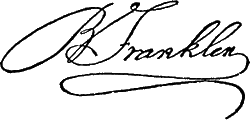
Example of a signature with a paraph

The word paraphe, which is also spelled parafe, came up last night at the French conversation group – we were looking for how to say initial (letter) in French and found this word, along with initiale.

The word also exists in English – paraph. Definitions include:

  • a flourish made after or below a signature, originally to prevent forgery
  • a flourish after a signature, originally to prevent forgery
  • a flourish or other embellishment made after a signature, either as idiosyncrasy or to protect against forgery

[Source]

It comes from via French from the Medieval Latin paraphus, a variant of paragraphus (paragraph).

Bassoonic

Bassoon

bassoonic (bəˈsuːnɪk) adjective – like a bassoon

One of the exercises we did at the singing class I went to this morning was to imagine our voices were like different instruments and coming from different parts of the body. The instruments were the flute (a smallish, narrow voice), the clarinet (a medium, wider voice), and the bassoon (a full, wide voice). One of us coined the word bassoonic to describe this type of voice, which we all thought was a great word.

There are probably technical terms to describe the different ways of breathing and singing involved, but we find it helps to use these types of images.

Grubstake

I came across the word grubstake in a book I’m reading at the moment and it caught my attention because I haven’t seen it before. It appears in the following context:

“From the moment I first arrived back in New York, my father has wanted me to leave the city. He would be happy to grubstake my move to greener pastures.”

From this I can guess that grubstaking probably involves providing financial support, though without the context one might guess that it might be a kind of food.

According to the Merriam-Webster dictionary, grubstake means:

1 : supplies or funds furnished a mining prospector on promise of a share in his discoveries
2 : material assistance (as a loan) provided for launching an enterprise or for a person in difficult circumstances

The American Heritage Dictionary provides the following definition:

1. noun Supplies or funds advanced to a mining prospector or a person starting a business in return for a promised share of the profits.
2. transitive verb To supply with funds in return for a promised share of profits.

The site Take Our Word For It defines a grubstake as

“a supply of food (grub) which a wealthy investor would provide a gold prospector in exchange for a share (stake) in whatever gold might be found.”

It was probably coined during the California gold rush of 1849 and first appeared in writing in 1863.

Grub has been as a slang word for food since at least 1650 and is still used in this way in the UK. Is it used in other Anglophone countries?

Tonnmharcaíocht

An interesting word I heard yesterday on Raidió na Gaeltachta was tonnmharcaíocht or surfing – literally “wave riding”. I hadn’t heard it before, but was able to work out the meaning from its component words. Another word for this kind of surfing is tonnscinneadh (wave glancing / skimming). Surfing the internet is scimeáil ar an Idirlíon, and sciméail also means to skim (milk).

Words related to marcaíocht (riding, to ride / drive / lift), include marcach (rider / horseman), marcaigh (to ride) and marcshlua (cavalry). The root of these is marc, the Old Irish word for horse, which is related to the Welsh march, the Cornish margh, and the Breton marc’h, all of which mean stallion.

The words for mare in Old High German (marah), Norse (marr), and Anglo-Saxon (mearh) as well as the English words mare and marshal are also related and can be traced back to the Proto-Indo-European *mark (horse).

Cennin Pedr

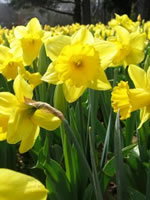
Daffodils / Cennin Pedr / Narcissi

Yesterday was St David’s Day (Dydd Gŵyl Dewi), a day when many Welsh people wear daffodils (cennin Pedr) in honour of their patron saint. The daffodil (cenhinen Bedr) is one of the national symbols of Wales, along with the leek (cenhinen), and the Welsh name for daffodil means “Peter’s leek”. The leek has been a Welsh symbol for many centuries and features prominently in traditional Welsh dishes such as cawl cennin (leek soup). The daffodil became popular as a national symbol during the 19th century, especially among women.

The names for daffodil in Irish, Manx and Scottish Gaelic are similar: lus an chromchinn, lus ny cam-ching and lus a’ chrom-chinn, which mean “bent-headed plant”. Alternative names in Manx include lus ny n’guiy (goose plant) and lus yn arree (Spring plant).

The English word daffodil is thought to comes from the Middle English affodill (asphodel), from the Middle Lation affodillus, from the Latin asphodelus, from the Greek asphodelos, the origin of which is unknown. The initial d perhaps came from a merging of the Dutch definite article de with affodil (Source).

According to Plutarch the Latin name for daffodil, narcissus, comes from the Greek ναρκαώ [narkao] (to numb), which is also the root of narcosis, as the plant which produces numbness or palsy (Source). Although other sources claim that the narcissus was named after Νάρκισσος [Narkissos], the character in Greek myths.

The daffodil or narcissus is a symbol of vanity in the West, while in China it’s a symbol of wealth and good fortune.

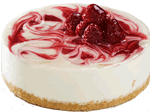
Word of the day – cheesecake

Cheesecake

One of the things we discussed last night at the French conversation group was cheesecake – a member of the group has a weakness for this dessert and couldn’t resist when she saw it on the menu.

We concluded that the word cheesecake is also used in French and that there probably isn’t a French word for it. According to my French dictionary though, cheesecake is flan au fromage blanc, and another possible translation is gâteau au fromage.

In Germany cheesecake is Käsekuchen or Quarkkuchen, in Switzerland it’s Quarktorte, and in Austria it’s Topfenkuchen, according to Wikipedia.

What about in other languages?

Word of the day – wintle

I came across the word wintle [‘winəl / ‘wintəl] in Louis de Bernières’ novel Notwithstanding, which I just finished reading. From the context – she walks carefully so as not to wintle on the rimy Bargate stones of the path – I guessed that it meant to slip or something similar.

According the Merriam-Webster Online Dictionary it’s Scottish and means to stagger, reel or wriggle. It’s possibly comes from the Dutch word windtelen (to reel).

Dictionary.com defines it as 1. (noun) a rolling or staggering motion. 2. (verb) to roll or swing back and forth. 3. (verb) to tumble over; capsize.

Have you heard this word before?

Word of the day – ortzikara

Today’s word, ortzikara, is Basque and means “time when a storm is brewing” or in Spanish “tiempo amenazado por la tormenta”. Do any other language have a single word to express this meaning?

This word comes from a book I’m reading at the moment – Mother Tongues – Travels through Tribal Europe, by Helena Drysdale, in which the author and her family travel through Europe visiting people who speak minority languages such as Basque, Occitan, Sami and Corsican.

Related words include ihortziri (thunder), tximista (lightning), truxu (light rain), euri (heavy rain), bisuts (torrential rain), zara-zara (heavy rain), ortzadar (rainbow), haize (wind), elur (snow) and bisutsa (light snow). In fact there seems to be quite a lot words in Basque for different kinds of weather.