Cerddoriaeth

Dwi’n hoff iawn cerddoriaeth, yn enwedig cerddoriaeth o Iwerddon, o’r Alban ac o Gymru. Teulu cerddorol yw nheulu i – mae fy mam yn canu mewn corau yn gyson ac yn canu’r piano o bryd i’w gilydd. Mae mrawd yn chwarae’r trymped a chwaraeodd y trombôn pan oedd e’n ifanc. Chwaraeodd ‘n chwaer y piano, y sielo ac y recorder, ond dydy nhad ddim yn chwarae unrhyw offerynnau.

Dechreuais innau chwarae’r piano pan o’n i’n saith oed, a chwaraeais am bum mlynedd. Ac wedyn, ar ôl i mi fethu yr arholiad cerddorol grâd 2, dechreuais chwarae’r clarinét a chwaraeais am saith mlynedd. Teimlais yn fwy brwdfrydig am chwarae’r clarinét na’r piano, felly ymarferais yn fwy aml a dysgais ef hyd at lefel eithaf uchel. Dysgais y sacsoffon ar fy mhen fy hun, a chwaraeais y clarinét bas am sbel hefyd. Ceisiais ddysgu’r gitâr a’r harmonica, ond heb mwy o lwyddiant.

Chwaraeais mewn bandiau yn yr ysgol, a mynychais ysgol cerddoriaeth lleol dwywaith yr wythnos lle chwaraeais mewn bandiau chwyth, bandiau mawr a cherddorfa. Canais yng nghôr yr ysgol am sbel hefyd.

Dechreuais chwarae y chwiban pan o’n i’n bymtheg oed a chwaraeais am bum mlynedd. Chwaraeais alawon o Iwerddon yn bennaf, dechreuais wrando ar cerddoriaeth o Iwerddon a syrthiais mewn cariad â’r iaith Gwyddeleg. Dyma y prif rheswm pam o’n i’n eisiau dysgu Gwyddeleg o hyn ymlaen.

Yn ystod fy ail blwyddyn yn y prifysgol, o’n i’n yn Taiwan, Japan a Tsieina a es i ddim â fy offerynnau. Na barheais chwarae nhw ar ôl ddes i adref, rhywbeth ydw i’n difaru yn fawr.

Pan es i i Glencolmcille ers dwy flynedd, dechreuais chwarae’r chwiban un waith eto, a dwi’n chwarae bron bod dydd bellach. Dw i’n canu caneuon yn y Wyddeleg, yn Aeleg yr Alban ac yn y Gymraeg yn aml hefyd. Ers i mi ddechrau dysgu Cymraeg, dw i wedi ymddiddori mewn cerddoriaeth yn y Gymraeg, yn enwedig roc a phop Cymraeg.

Ceol

Is breá liom ceol, go háirithe ceol as Éirinn, as Albain agus ón Bhreatain Bheag. Tá ceol ag beagnach gach éinne i mo theaghlach (ach amháin m’athair) – bíonn mo mháthair ag seinm an pianó agus bíonn sí ag canadh sna cóir chomh maith. Bíonn mo dheartháir ag seinm an stoc agus bhí sé ag seinm an trombón nuair a bhí sé níos óige. Bhí mo dheirfiúr ag seinm an pianó, an dordveidhil agus an fhliúit Shasanach.

Thosaigh mise an pianó a sheinm nuair a bhi mé seacht mbliana d’aois, agus bhí mé ag seinm ar feadh cúig bhliana. I ndiaidh theip an scrúdú ceoil grád 2 orm, thosaigh mé an chláirnéid a sheinm agus bhí mé ag seinm ar feadh seacht mbliana. Bhí mé níos díograiseach faoi an chláirnéid a sheinm na an pianó, dá bhrí sin, chleacht mé níos minice agus d’fhoghlaim mé í go dtí leibhéal measartha ard. D’fhoghlaim mé an sacsafón ar m’aonar, agus sheinm mé an dordchláirnéid ar feadh tamall freisin. Bhain mé triail as an giotár agus an orgán béil a fhoghlaim chomh maith, ach gan rath.

Sheinm mé i bannaí ar scoil, agus d’fhreastail mé scoil ceoil áitiúil dhá uair sa seachtain cá sheinm mé i bannaí gaoith, bannaí mór agus ceolfhoireann. Chanadh mé i cór na scoile ar feadh tamall freisin.

Thosaigh mé an fheadóg stáin a sheinm nuair a bhí mé cúig bliana deich d’aois. Sheinm mé foinn Gaelach go príomha, thosaigh mé ag éisteacht le ceol Gaelach agus thit mé i ngrá leis an Ghaeilge. Sin é an príomh-fhail atá mé ag iarraidh Gaeilge a fhoghlaim as sin amach.

I rith na dara bhliana dhom san ollscoil, bhí mé i Taiwan, sa tSeapáin agus sa tSín, agus níor thug mé m’uirlisí liom. Níor lean orm iad a sheinm i ndiaidh tháinig mé abhaile, rud éigin atá aithreachas orm faoi.

Nuair a chuaigh mé go Gleann Cholm Cille dhá bhliain ó shin, thosaigh mé an fheadóg stáin a sheinm arís eile, agus bím ag seinm beagnach gach lá anois. Bím ag canadh amhráin i nGaeilge, i nGaeilge na hAlbain agus as Breatnais go minic chomh maith.
Are you computarded?

When reading this blog today, I noticed a interesting word in the comments on one of the posts – computarded. It was used in the following sentence: “I made it up to the basic internet skills era (email! google search! social network site! PubMed! etc…) and beyond that I’m computarded.”

This is an example of a portmanteau word or blend. It works better than computer illiterate, I think, though only if you’re talking about yourself. If you used it to describe someone else, it might be considered pejorative.

A possible antonym is compudextrous. Can you think of any others?

Speaking with a foreign accent

I came across an interesting post today over on David Crystal’s blog about foreign accents. He believes that as long as other people can understand what you say in a foreign language, it doesn’t really matter if you speak it with a non-native accent. In fact your accent conveys your identity. He states that “it is very rare indeed for someone to develop a phonetic ability to the extent that their foreign origins are totally masked”, and that the only people who would really need to do so are spies.

It is indeed very difficult to speak a foreign language with completely native pronunciation and intonation, unless you acquire it at a young age. Having a training in phonetics certainly helps, as does prolonged immersion in the language. It also helps if you’re a good mimic.

I do my best to acquire as near a native accent as possible in the languages I’m learning, and my accent tends to improve if I spend a lot of time speaking those languages with native speakers. When people ask me which part of their country I’m from, or assume I’m from a neighbouring country where the same language is spoken, I know I’m one the right track.

Do you think it matters if you have a ‘foreign’ accent when speaking another language?

Language puzzle

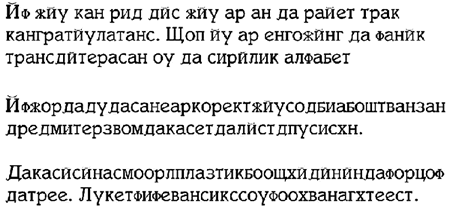
Today’s language puzzle was sent in by Alan & Debbie Willis. It’s a clue for a Geocaching waypoint. Can you decipher it? It appears to be written in English using a Cyrillic-based cypher.

Mystery clue for a Geocaching waypoint

Here’s what I’ve managed to work out so far:

If you can read this you are on the right track congratulations. Stop you are enjoying the ???? transliterated in the Cyrillic alphabet.

If you’re the last one are correct you …

By the way, in case you’re wondering what Geocaching is all about, there’s some information on this site.

Gleann Cholm Cille

Is áit álainn agus ciúin í Gleann Cholm Cille, bíonn muintir na háite cairdiúil agus fáilteach agus bíonn an craic go hiontach sna títhe tábhairne. Is áit an iargúlta í chomh maith agus bíonn an aimsir go dona go minic, ach is breá liom í. Tá sé cosúil leis an áit ar tógadh mé – sráidbhaile beag cois farraige in iarthuaisceart Shasana. I mbliana bhí mé ansin ar feadh an tríú huair, agus rachaidh ar ais go cinnte.

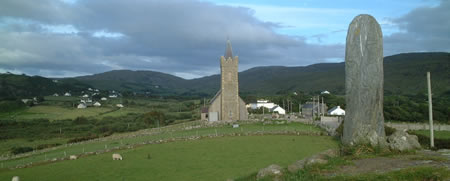
A view of Gleann Cholm Cille

Lle hyfred a llonydd ydy Gleann Cholm Cille, mae’r pobl leol yn gyfeillgar a chroesawgar, a mae lot o hwyl yn y tafarndai. Lle unig ydy e hefyd ac mae’r tywydd yn arw yn aml, ond dwi’n ei hoff iawn e. Mae e’n tebyg i’r ardal lle ges i fy magu – pentref bach ar lan y môr yng ngogledd orllewin Lloegr. Eleni o’n i’n yna am y trydedd tro, a bydda i’n ôl yn ddi-os

Word of the day – corpus

A text corpus (pl. corpora) is a large and structured set of texts usually stored, processed and analysed electronically. They are used to do statistical analysis, checking occurrences or validating linguistic rules. They are also used by dictionary makers to find definitions of words. The word corpus comes from the Latin for body.

According to an article in the New York Times on this topic that I found today, the verb migrate is used much more frequently with the direction south than with north. Pink things tend to be fluffy, while green things are more likely to be fuzzy. We tend to chide ourselves but we are more likely to lambaste others. The word fake is most commonly associated with smiles, tans, IDs, passports, fur and boobs.

The article contains many other interesting examples, all taken from the Oxford English Corpus (OEC), a 1.8-billion-word database of written and spoken English.

I found another corpus of English today that’s accessible online: the British National Corpus – it’s smaller than the OEC – only 100 million words – and covers mainly British English.

Do you know of similar corpora for other languages?

Duxes and testamurs

Two words I came across recently that left me puzzled were dux and testamur. After some investigation, I discovered that dux is the title given to the top academic student in a graduating class of a school, and that it’s used in Scotland, Australia, New Zealand and Iceland. I understand that the US equivalent is valedictorian. I don’t know if there’s an equivalent in England or Wales.

Dux comes from the Latin word for leader, via the verb ducere, to lead, and is also the root of the English word duke, the French duc, the Italian duce, and the Venetian doge.

A testamur or testimonium is a certificate issued by a university to signify that a student has satisfied the requirements of a particular course and has graduated, according to this site. It’s used mainly in Australia. Elsewhere I believe such documents are usually called diplomas.

Testamur comes from the Latin Ita testamur, meaning “We testify/certify” – the words used to begin such certificiates, according to Wikipedia.

Aonbheannaigh / Uncyrn

Ar an mbus go Gleann Cholm Cille, bhuail mé le buachaill as Baile Átha Cliath agus rinne muid comhrá faoi gach cineál seafóid. Dúirt sé liom go raibh sé ag caint le turasóirí o Meiriceá uair amháin agus dúirt sé leo go bhfuil aonbheannaigh agus leipreachain i nDún na nGall. Chreid siad go bhfuil aonbheannaigh ann, ach ní thug siad isteach go bhfuil leipreachain ann, go dúirt sé leo “Is mise ceathrú leipreachán”!

Ar y bws i Gleann Cholm Cille, mi gwrddais â llanc o Ddulyn a sgwrison ni am llawer o bethau lol. Mi ddywedodd e oedd e’n sgwrsio gyda twristiaid o’r Unol Daliethiau unwaith a dywedodd e bod uncyrn a leprechaun yn Donegal. Mi goelion nhw mewn yr uncyrn, ond na goelion nhw bod leprechaun yn bodoli, hyd y ddywedodd e, “chwarter leprechaun ydw i”!

On the bus to Glencolmcille I met a lad from Dublin and we chatted about all sorts of nonsense. He told me that he was talking to some American tourist one time and told them that there are unicorns and leprechauns in Dongel. They believed in the unicorns, but not in the leprechauns, until he mentioned that he himself quarter leprechaun!

Word of the day – Bowser

Today’s word, bowser, has been mentioned a lot on the radio and on TV here recently. In the UK a bowser is a mobile water tank used to supply fresh water in emergency situations, such as the recent/current floods, where normal supplies have broken down or are insufficient.

You can see some examples of water bowsers here.

Bowsers got their name from Sylvanus Bowser, an early designer of petrol pumps in Australia who founded the the company, S.F. Bowser, Inc., a pioneer in the production of fuel handling and oil purification equipment. Bowser is used as a trade name for petrol pumps in Australia and Canada, and the word’s meaning has expanded to cover other kinds of pumps, and also water tanks and fuel tanks.

Source: http://en.wikipedia.org/wiki/Bowser