Here’s a recording in a mystery language.
Do you know or can you guess the language, and do you know where it’s spoken?
Here’s a recording in a mystery language.
Do you know or can you guess the language, and do you know where it’s spoken?
I discovered the other day the the exclamation mark (!), which is apparently known as an exclamation point in American English, has a number of other names. When it was first introduced by printers in the 15th century, it was known as a sign of admiration or exclamation or the note of admiration in English.
In the early 20th century it was known as an ecphoneme [source]. A related word is eroteme, which is another name for the question mark (?), and comes from the Ancient Greek ἐρώτημα (erṓtēma – question), from ερωτώ (erotó – to ask) [source].
In 1950s American typesetting manuals it was referred to as a bang. Related punctuation marks are the interrobang (‽), a combination of an exclamation mark and question mark that was invented in 1962 by Martin K. Speckter, an American advertising executive [source], and the gnaborretni (⸘), an inverted interrobang [source].
Printers might call it a screamer, gasper, slammer or startler.
British hackers apparently call it, or called it, a shriek or pling, which is my favourite name for this punctuation mark.
In Welsh the exclamation mark is known as a ebychnod, from ebychu (to exclaim) and nod (mark), or rhyfeddnod, from rhyfedd (strange, odd) and nod.
In Armenian the equivalent of the exclamation mark (see below) is known as a Բացականչական նշան (Bats’akanch’akan nshan) or “exclamatory mark/sign” or “screamer”.
Here are some exclamation marks in other alphabets:
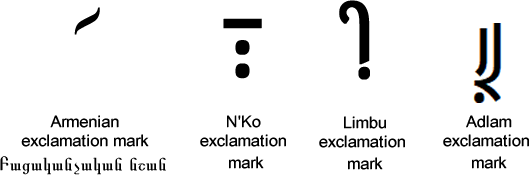
What is the exclamation mark called in other languages?
Here’s a video I made last week about the word exclamation:
An interesting word I learnt yesterday from the Something Rhymes With Purple podcast was snirtle, which means “to try to suppress your laughter (often without success)”.

According to the Merriam-Webster dictionary it is Scots and means “to laugh with snorts”, and Wiktionary defines it as “to snigger” or “a snigger”.
According to Dictionaries of the Scots Language /
Dictionars o the Scots Leid, snirtle [ˈsnɪrtəl] is a variation of snirt, which means “to snigger, to make a noise through the nose when attempting to stifle laughter, to sneer”, “to snort, to breathe sharply and jerkily through the nose”, or “a snigger, a suppressed laugh”.
Some related expressions and examples of how it’s used:
Snirtle and snirt are probably initative of the sounds you make when you snirt or snirtle.
Are there words with similar meanings in other languages?
Here’s a recording in a mystery language.
Do you know or can you guess the language, and do you know where it’s spoken?
One of the Spanish words I learnt today was ¡guácala! [ˈɡwa.ka.la], which means yuck! ew! gross! it’s disgusting! and similar exclamations of disgust. It’s used in El Salvador, Honduras, Mexico and the Dominican Republic to indicate dislike, disgust, or rejection [source].
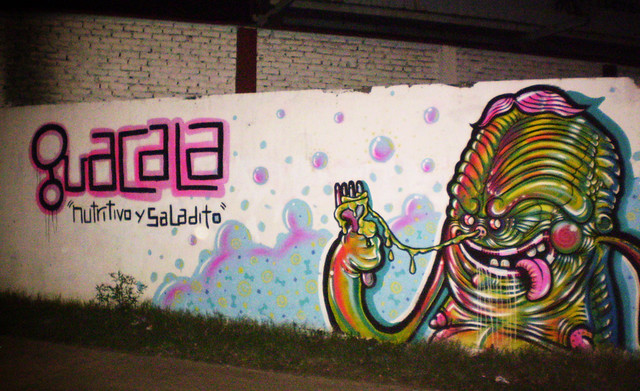
It comes from guacal (wooden crate, tub, calabash tree), from the Classical Nahuatl huacalli [kwaˈkalːi] (wooden crate) [source]. Why a word for a wooden crate became an exclamation of disgust is not clear.
Here are some examples of how it’s used (from ReversoContext and Duolingo):
Related words include:
Both of which are used in Mexico.
Other Spanish words with a similar meaning include:
Are there other words in Spanish with a similar meaning?
What about equivalent words in other languages?
One of my favourite expressions in Welsh is ych a fi! [əx ə viː], which means yuck! [source].
The word ych, pronounced [ɨːχ/iːχ], also means ox.
An interesting Spanish word I learnt today is cometa [koˈmeta], which means both kite and comet. It comes from the Latin word comēta, an alternative version of comētēs (comet, meteor, shooting star; portent of disaster), from the Ancient Greek κομήτης (komḗtēs, – longhaired, comet), which refers to the tail of a comet, from κομᾰ́ω (komáō – let the hair grow long) and -της (-tēs – a suffix that forms nouns) [source].

Related words and expressions include:
Other words for kite in Spanish include [source]:
Are there any other words for kite in other Spanish-speaking countries?

Kite, as in the bird of prey of the subfamily Milvinae, is milano in Spanish, which also means the down of a thistle and flying gurnard (Dactylopteridae) – a type of fish. This comes from the Vulgar Latin *milānus, from the Latin milvus (kite, gurnard) [source].
Here’s a recording in a mystery language.
Do you know or can you guess the language, and do you know where it’s spoken?
If someone told you they were feeling a bit nesh, would you know what they meant?
Nesh [nɛʃ] means “sensitive to the cold” and “timid or cowardly”, according to Dictionary.com, and is apparently used in in northern and Midlands English dialects. Although I grew up in the northwest of England, I’d never heard it before a friend mentioned it yesterday.
According to Wiktionary it means:
As a verb it means “to make soft, tender or weak”, or “to act timidly”.
It comes from the Middle English nesh/nesch/nesche, from the Old English hnesċe/ hnysċe/hnæsċe (soft, tender, mild; weak, delicate; slack, negligent; effeminate, wanton), from the Proto-West Germanic *hnaskwī (soft), from the Proto-Germanic *hnaskuz (soft, tender), from the Proto-Indo-European *knēs-/*kenes- (to scratch, scrape, rub).
Related words include:
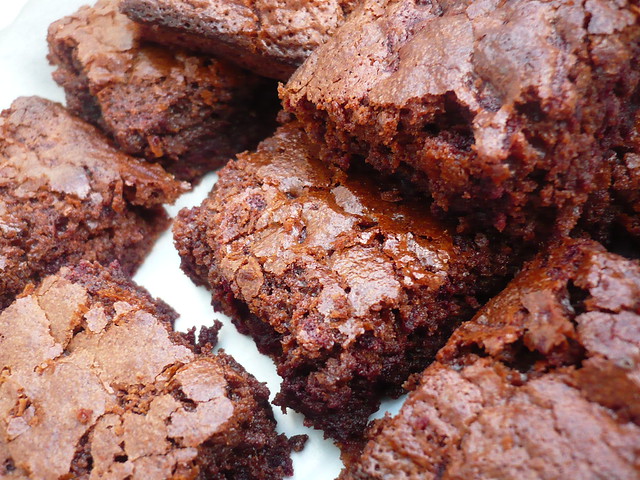
From the same roots we get the German word naschen (to nibble, to eat sweets on the sly), and the English word nosh (food, a light meal or snack, to eat), via the Yiddish word נאַשן (nashn – to snack, eat) [source].
In Spanish the word llama has several different meanings. As well as being a domesticated South American camelid of the genus Lama glama, it also a flame, and means “he/she/it calls”, or in other words the third person singular present tense form of the verb llamar (to summon, call, knock, ring). Each version of llama comes from a different root [source].
The animal llama [ˈʎama] comes from the the Quechua word llama. Other members of the genus lama include:

The flaming version of llama, which is pronounced [ˈʝama/ˈɟ͡ʝa.ma], is an alternative version of flama (flame), and comes from the Latin flamma (flame, fire), from the Proto-Italic *flagmā, from Proto-Indo-European *bʰlē- (to shimmer, gleam, shine) [source].

Some English words from the same root include flame, flambé and flagrant.
Llamar [ʝaˈmaɾ/ɟ͡ʝaˈmaɾ] (to summon, call, etc) comes from the Old Spanish lamar, from the Latin clāmāre, from clamō (cry out, clamer, yell, shout), from the Proto-Indo-European *kelh₁- (to shout) [source].
Words from the same root include acclaim, claim, clamour, council and haul [source].
When I see words beginning with a double l, which are quite common in Spanish, I have to stop myself giving them a Welsh pronounciation [ɬ]. There is in fact a Welsh word which resembles llama – llamu, which means to jump, leap, bound, spring. It comes from the Proto-Celtic word *lanxsman (jump), from the Proto-Indo-European *h₁lengʷʰ- (light; move lightly) [source]. The Welsh for llama is lama, by the way.
Here’s a recording in a mystery language.
Do you know or can you guess the language, and do you know where (and when) it was spoken?