Modern Arabic Latin Script (Al-Ƹarabijà al-Latinijjà al-moƹaṣirà)
The Modern Arabic Latin Script (MALS) was devised by Sheth Al-Ghamidi as a way to Latinize Arabic without the need to resort to old ways and the excessive usage of diacritics.
MALS preserves all orthography of Arabic accurately without watering down or overengineering specific letters via diacritics.
Notable features
- Type of writing system: alphabet
- Direction of writing: left to right
- Used to write: Arabic (العربية)
- MALS was designed to be practical and usable in everyday writing, not just in theory.
- MALS avoids any excessive usage of diacritics as they are unneeded in terms of every-day usage, and excessive diacritics can cause confusion across the Arabic dialect continuum; the further the speaker is from your dialect, the harder it is to understand them. This script fixes that problem entirely.
- The script allows for a singular digraph, "th" representing the /θ/ sound, avoiding overcomplication.
Modern Arabic Latin Script
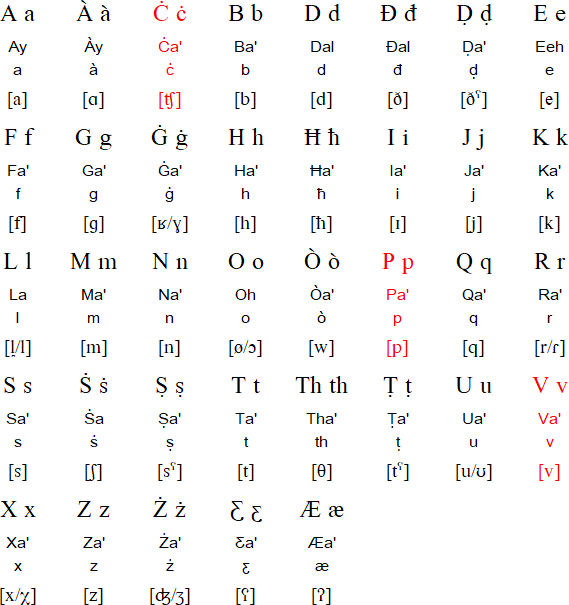
Download a script chart for the Modern Arabic Latin Script (Excel)
Rules
- The red letters are used in loanwords.
- Glottal stop usage (Æ, æ): It is most always used in the middle of the word or at the start, whereas you put it before a letter which recognizably becomes a vowel. Take for example: "Æiestƹiżab" [is.tiʕ.ˈd͡ʒaːb] although it is not needed it is important and critical as a marker for people to have a smoother and faster reading.
- Definitive article: "-" should be used after the Definitive article. (The rule of Definitive Articles work on the Loan-letters, which are in red.) "The" maintains the same spelling, only changing with "sun letters" which are letters that get pronounced and replace the "L" that's in place, which are: D, Đ, Ḍ, T, Ṭ, TH, R, S, Ṡ, Ṣ, L, N, Ċ. Example: "Ash-shams" (The Sun), even though it is written as "Al-Shams" in Arabic, it is pronounced as Ash-shams. Thus with MALS, you'd write it as "Aṡ-ṡams". While "moon letters", that are: A, À, B, E, F, G, Ġ, H, Ħ, I, J, K, M, O, Ò, P, Q, U, V, X, Ż, Ƹ.
remain as the article "Al" or "Il" depending on the tone and the dialect of the person speaking/writing, the system is rigid in place, but due to the dialect continuum, "Il" and "Al" are both considered accurate
- Usage of foreign letters Ċ, P, V: Those letters are used mostly in newly-coined terms and ones that did not get Arabized. For example, an Arabized term: "Philosophy" becomes "Fajlasofià" [fajlaˈsofɪɑ] due to the Arabization. Whereas the term: such as the word "Chewbacca" has not been Arabized, thus it becomes "Ċeòbakka" [tʃeˈwabakka].
- Usage of Capitalization: follows the rules of English capitalization.
- Elongated vowels: Some vowels can be elongated via the use of supplemented letters with Macrons, which are:
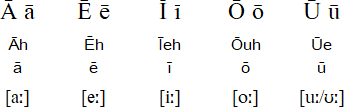
These letters are not mandatory nor are they important in day-to-day conversing, which is why it is mostly used in scholarly examples, i.e. Quranic Arabic & M.S.A.
- Note: For the separation of the letter "ظ" and "ض" you can use "Dh" as an equal for the latter. But due to merging and dialects fading them into one sound, Ḍ is sufficient enough.
Sample text (in Modern Standard Arabic)
Żamiƹ al baṡar maxloquen aħrar ò mutasaòijen fil ṡaraf ò al ħuqoq. Humm maàobijen bil asbàb ò al ḍamirr ò jażijeb ƹalijehum at-taƹamul maƹ baƹḍum fi roħ oxaòòijaà.
Transliteration (Arabic script)
جميع البشر مخلوقين احرار و متساوين في الشرف و الحقوق, هم موهوبين بالأسباب و الضمير و يجب عليهم اتعامل مع بعضهم في روح أخوية.
Translation
All human beings are born free and equal in dignity and rights. They are endowed with reason and conscience and should act towards one another in a spirit of brotherhood.
(Article 1 of the Universal Declaration of Human Rights)
Information about Arabic |
Phrases |
Numbers |
Tower of Babel |
Articles |
Links |
Arabic courses on: Amazon.com and
Amazon.co.uk [affilate links]
Constructed scripts for: Ainu |
Arabic |
Chinese languages |
Dutch |
English |
French |
Hawaiian |
Hungarian |
Japanese |
Kadazandusun |
Korean |
Lingala |
Malay & Indonesian |
Persian |
Tagalog / Filipino |
Russian |
Sanskrit |
Spanish |
Taino |
Turkish |
Vietnamese |
Welsh |
Other natural languages |
Colour-based scripts |
Tactile scripts |
Phonetic/universal scripts |
Constructed scripts for constructed languages |
Adaptations of existing alphabets |
Fictional alphabets |
Magical alphabets |
A-Z index |
How to submit a constructed script
[top]

Note: all links on this site to Amazon.com , Amazon.co.uk
 and Amazon.fr
 are affiliate links. This means I earn a commission if you click on any of them and buy something. So by clicking on these links you can help to support this site.
You can support this site by Buying Me A Coffee, via PayPal or Patreon, or by contributing in other ways.
If you find all the adverts annoying, there is now an Ad-free version of Omniglot which you can access for a small monthly or annual donation.
This website and its content is copyright of Simon Ager - © Simon Ager 1998-2026. All rights reserved. All images were created by me, unless otherwise indicated. More details

[top]