
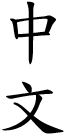
Chinese belongs to the Sinitic or Chinese branch of Sino-Tibetan language family. The modern varieties of Chinese all descended from Middle Chinese (中古汉语 [中古漢語]), which was spoken in China during Southern and Northern Dynasties, and the Sui, Tang, and Song dynasties (c. 5th - 12th centuries AD), and which developed from Old Chinese (上古汉语 [上古漢語]), which was spoken during the Shang and Zhou Dynasties and the Warring States Period (c. 1600-256 BC).
Chinese is spoken by about 1.35 billion people mainly in the People's Republic of China, the Republic of China (a.k.a. Taiwan), Singapore and other parts of Southeast Asia. There are also communities of Chinese speakers in many other parts of the world.
Varieties of spoken Chinese are traditional grouped into the following major groups:
Chinese languages or dialects? | More information about spoken Chinese
Written Chinese: Oracle Bone Script, Simplified characters, Bopomofo, Types of characters, Structure of written Chinese, Evolution of characters, How the Chinese script works, Xiao'erjing, General Chinese
Spoken Chinese: Mandarin, Dungan, Wu, Shanghainese, Wenzhounese, Yue, Cantonese, Weitou, Min, Jian'ou, Taiwanese, Teochew, Fuzhounese, Puxian, Hakka, Xiang, Gan, How many people speak Chinese?
Other Chinese pages: Chinese numbers (數碼) | Chinese classifiers (量詞) | Electronic dictionaries | Chinese links | Books: Chinese characters and calligraphy | Cantonese | Mandarin, Shanghainese, Hokkien and Taiwanese
The different varieties of Chinese are known as 方言 (fāngyán), which is translated as 'regional languages', 'toplects', 'dialects' or 'varieties'. The English term dialect normally refers to mutually intelligible varieties of a single language, though the distinction between dialects and languages is often for sociological and political reasons rather than linguistic ones. Chinese people generally refer to Chinese as a single language with a number of different dialects or varieties. However there is little mutual intelligiblity between the different varieties of Chinese and as a result some non-Chinese linguists refer to them as separate languages.
A distinction is made in Chinese between spoken and written language. In China the written form of Chinese, which is perceived as being uniform throughout the country is referred to as 中文 (zhōngwén), while the terms 语 [語] (yǔ) or 话 [話] (huà) are used in the names of spoken varities of Chinese, e.g. Mandarin Chinese is known as 汉语 [漢語] (hànyǔ) = "Han language", or 普通话 [普通話] (pǔtōnghuà) = "common language" in China. elsewhere it is refered to as 国语 [國語] (guóyǔ) = "national language" or 华语 [華語] (huáyǔ) = "Chinese language". The word 汉 [漢] (hàn) is used to refer to the Chinese people and comes from the Han Dynasty (206 BC - 220 AD).
Mandarin, Dungan, Wu, Shanghainese, Wenzhounese, Yue, Cantonese, Weitou, Min, Jian'ou, Taiwanese, Teochew, Fuzhounese, Puxian, Hakka, Xiang, Gan
[top]
The main written form of Chinese is based mainly on the Mandarin spoken by educated people in Beijing.
Chinese is written with characters (汉字 [漢字] hànzì) which represent both sound and meaning. Words in Chinese can be made up of one of more syllables and each syllable is represented by a single character. There are relatively few different types of syllable in spoken Chinese - about 1,700 in Mandairn, compared to languages like English with over 8,000 - yet there are tens of thousands of characters. As a result there are multiple characters for each syllable, each of which has a different meaning. This type of writing system is known as semanto-phonetic, logophonetic, morphophonemic, logographic or logosyllabic.
Oracle Bone Script, Simplified characters, Bopomofo, Types of characters, Structure of written Chinese, Evolution of characters, How the Chinese script works, Xiao'erjing, General Chinese, New Phonetic Character (for Shanghainese)
人人生而自由﹐在尊嚴和權利上一律平等。他們賦有理性和良心﹐並應以兄弟關係的精神互相對待。
人人生而自由,在尊严和权利上一律平等。他们赋有理性和良心,并应以兄弟关系的精神互相对待。
Rénrén shēng ér zìyóu, zài zūnyán hé quánlì shàng yīlǜ píngděng. Tāmen fùyǒu lǐxìng hé liángxīn, bìng yīng yǐ xiōngdì guānxì de jīngshén hùxiāng duìdài.
人人生者
均有權法
有知情仁
必為人弟
Transliteration (Mandarin pronunciation)
Rén rén shēng zhě
jūn yǒu quán fǎ
yǒu zhī qíng rén
bì wéi rén dì
Translated by the Magistri Classical Chinese Tutor
All human beings are born free and equal in dignity and rights. They are endowed with reason and conscience and should act towards one another in a spirit of brotherhood.
(Article 1 of the Universal Declaration of Human Rights)
Written Chinese: Oracle Bone Script, Simplified characters, Bopomofo, Types of characters, Structure of written Chinese, Evolution of characters, How the Chinese script works, Xiao'erjing, General Chinese
Spoken Chinese: Mandarin, Dungan, Wu, Shanghainese, Wenzhounese, Yue, Cantonese, Weitou, Min, Jian'ou, Taiwanese, Teochew, Fuzhounese, Puxian, Hakka, Xiang, Gan, How many people speak Chinese?
Other Chinese pages: Chinese numbers (數碼) | Chinese classifiers (量詞) | Electronic dictionaries | Chinese links | Books: Chinese characters and calligraphy | Cantonese | Mandarin, Shanghainese, Hokkien and Taiwanese
Akkadian Cuneiform, Ancient Egyptian (Demotic), Ancient Egyptian (Hieratic), Ancient Egyptian (Hieroglyphs), Chinese, Chữ-nôm, Cuneiform, Japanese, Jurchen, Khitan, Linear B, Luwian, Mayan, Naxi, Sawndip (Old Zhuang), Sui, Sumerian Cuneiform, Tangut (Hsihsia)
Page last modified: 25.05.24
[top]

You can support this site by Buying Me A Coffee, and if you like what you see on this page, you can use the buttons below to share it with people you know.

If you like this site and find it useful, you can support it by making a donation via PayPal or Patreon, or by contributing in other ways. Omniglot is how I make my living.

Note: all links on this site to Amazon.com


[top]


