
These are questios that I am asked quite frequently. If you cannot find the answers to your questions here, you can contact me at:

I cannot guarantee that I'll be able to answer your questions, but I'll do my best.
Please see the your name in... links page.
Please note that there is a difference between translating a name and transliterating a name. The former involves finding the meaning of the name and then trying to find a name with the same or a similar meaning in another language. The latter involves using a different writing system to represent the sounds of the name.
For example the name Anna comes from the Hebrew name חַנָּה (Hannah), which means "favor" or "grace". Transliterations of Anna in other writing systems include Άννα (Greek), Анна (Cyrillic), Աննա (Armenian), ანა (Georgian) and アナ (Japanese Katakana).
Names with similar meanings to Anna, i.e. translations, include Amara (Igbo), Armo (Finnish), فضل (Fadl - Arabic), लावण्या (Lavanya - Sanskrit), and سناز (Sanaz - Persian).
[top]
No, sorry. I'm not a translator, I don't offer any translation-related services, or have any contacts with translators.
Please post your translation requests on the Omniglot Facebook page - there are over 27,000 people there who can help.
If you would like a translation for a tattoo, I recommend that you ask an experienced translator, and check the translation with a native speaker of the language in question.
Many English words have multiple meanings, and in other languages there might be different words for each meaning. So it helps to be as precise as possible about the meaning you're trying to convey, especially for individual words.
Here are some places you can try for transliterations and translations into other languages and writing systems:
Multilingual Translation
http://www.freelang.net/translation/
http://www.oasisllc.com/transtrad/forum.htm
http://ackuna.com/
Arabic, Chinese, Hebrew, Japanese, Hindi, Gujarati, Sanskrit, Tamil, Telugu, Thai
http://www.tattoos-by-design.co.uk
"Ask the Experts" - contact details of people willing and able to answer questions about a wide range of languages: http://www.carla.umn.edu/lctl/resources/experts.html
Online translation sites | Online dictionaries | Electronic dictionaries and translators
[top]
Unfortunately I cannot help you as I don't maintain a database of translators and cannot recommend any translators or interpreters.
Please try posting your translation requests on:
www.proz.com
www.translatorsbase.com
[top]
Sorry, you can't - there is no Omniglot database of translators, and I cannot offer you any work, so please do not send me your CV.
There are databases of translators at: www.translatorstown.com, www.proz.com and www.translatorsbase.com
If you are a translator, interpreter or work with languages in some other capacity, please consider submitting an article to my language-related articles section.
[top]
Please post your requests on the Omniglot Facebook page - there are over 27,000 people there who can help you.
[top]
I will consider publishing articles from writers and bloggers who write about languages and related topics.
For details see: How can I submit an article?
[top]
I will consider linking to websites that provide free language-related material.
If you have an affiliate program and are in a language-related field, I will consider joining your program and linking to you.
[top]
Yes, you certainly can.
I leave the type of link up to you, but here are some suggestions for the wording of text links, if you need them:
Here are some Omniglot banners you could use:


If you would like other sizes or colours, just let me know.
[top]
I will consider placing ads for companies and organisations in language-related fields, though not custom writing services.
[top]
Can you be more specific? What kind of cooperation do you have in mind?
[top]
Possibly, but usually I don't have time for such reviews.
[top]
If you have read the About page, you will realise that Omniglot is a one-man operation. I have no plans to take on other people, so there no vacancies here and there is no point in you sending me your CV.
For jobs involving languages, please try this page.
You can learn the basics of many different languages on Omniglot, but I do not offer any taught courses, and I am not looking for any tutors or teachers.
If you are a language teacher or tutor, please read the question above.
[top]
If you have invented a new alphabet or other writing system and would like me to add it to this site, first send me a sample text. If your alphabet looks good and really appeals to me, I will consider adding it to Omniglot.
Please note: only conlangs written with interesting and attractive invented scripts will be considered for inclusion on this site.
The address to write to is:
My name is Simon Ager.
More details of how to submit a con-script to Omniglot
[top]
Only if it's written with an invented writing system that appeals to me.
Details of how to submit a con-script to Omniglot
[top]
Probably not, unless you have devised a way of writing a language with an alphabet not usually used to write it. For example, English with the Cyrillic alphabet or Ukrainian with the Latin alphabet.
More details of how to submit a con-script / adapted script to Omniglot
[top]
If you've written a language-related book or other publication and would like it to appear in the Omniglot book store, you can send me the details. If I think it's suitable and it's available on one of the Amazon sites (Amazon.com, Amazon.co.uk or Amazon.fr) I will add it.
The address to write to is:
My name is Simon Ager.
[top]
Probably because I haven't got round to adding it yet or haven't found sufficient information about it. If you can recommend any good sources of information, please do so. Details of the pronunciation of languages are usually the most difficult thing to find.
[top]
Those particular symbols represent the 'th' in the and the 'th' in three respectively. They belong to the International Phonetic Alphabet (IPA) and you can find out more at:
http://en.wikipedia.org/wiki/International_Phonetic_Alphabet
http://www.nativlang.com/linguistics/ipa-pronunciation-lessons.php
http://cmed.faculty.ku.edu/acdapres/rabeipa/index.html
https://linguischtick.wordpress.com/ipa/
https://www.youtube.com/watch?v=PBo5LAVYtX4
https://www.youtube.com/watch?v=r2frVKeVTKU
[top]
You could:
Why not share this page?
People who have contributed to this site
[top]
26th April 2024
[top]
If you want to use the material for non-commercial purposes, you're welcome to do so. Don't forget to mention where the material came from.
I suggest something along the lines of the following as way to cite Omniglot in your formal papers, assignments or essays:
Ager, Simon. "Omniglot - writing systems and languages of the world".
Date accessed: 26th April 2024. www.omniglot.com
Omniglot was first published on the web in November 1998, and was last updated on 26th April 2024.
If you would like to use material for commercial purposes, such as in books or computer programs, please contact me. Let me know if you need images in a different format or with a different colour background or dimensions. I will do my best to comply with your requirements. There may be a charge for this.
If you would like to copy or re-use any of the language-related articles, please ask the authors for permission. Contact details of the authors can be found at the bottom of some articles, if they're not there, please contact me, and I'll try to find them for you.
Unless otherwise indicated, all text and images on Omniglot are my own creations. The only exceptions are the images of writing systems invented by visitors
[top]
When citing online sources you generally give the date you accessed the resource. For example:
Ager, Simon. "Welsh language, alphabet and pronunciation".
http://www.omniglot.com/writing/welsh.htm
Date accessed: 26th April 2024.
Omniglot was first published on the web in November 1998, and was last updated on 26th April 2024. If you really need to know when a particular page was published, I might be able to find out.
On writing and language profile pages you can find the date the page was last modified at the bottom, and in some cases, the date the page was created.
For further advice on citing online sources, see:
https://www.scribbr.co.uk/referencing/harvard-website-reference/
[top]
I use NoteTab Light, a free text editor, to edit the HTML and CSS files. I create most of the script charts in Excel, then take screenshots and save them as images using Fireworks. Some charts and other images are created in Fireworks. I use Audacity, a free sound editor, for sound files.
[top]
On alphabet charts I usually use Arial Unicode MS (bundled with Windows) for transliterations and Doulos SIL for the IPA (International Phonetic Alphabet). For the actual letters of the alphabets and writing systems I use Doulos SIL, or another font that includes them all.
Most of the fonts I downloaded from various sites on the web. The rest came with programs or operating systems I've bought. A few have been sent to me by people who have invented scripts.
A list of the fonts used on this site
Links to sites where you can download many of these fonts
Download fonts for scripts invented by visitors to Omniglot
[top]
The Omniglot title that appears at the top of every page is in a Vietnamese font called Hoang Yen, which you can download here (TrueType, 35K). I added an inner bevel to it to make it stand out.
[top]
 What does the Omniglot logo mean?
The Omniglot logo is simply the word 'omniglot' written vertically and sideways. It's an example of Vertical English Character and Calligraphy (VEC) - a way to write English that looks like like seal-style Chinese characters. To read it as English you need to look at it sideways.
[top]
[top]
Not at the moment. I make changes to this site more or less every day so a static copy would become out of date very quickly. I think the web is the best place for a site of this kind.
Some alphabet charts are available for downloading in Excel, Word and PDF format
[top]
I coined the term in 1998 as the name of a website design and translation business I was trying to start. The business never took off, but the website I built for it eventually became Omniglot.
Omniglot ('ɒmnɪˌglɒt) noun
1. having a command of all languages
2. written in, composed of, or containing all languages
3. a person with a command of all languages
4. a book containing several versions of the same text written in all languages
5. a mixture or confusion of languages
[from Latin omnis (all) + Greek γλωσσα (glossa) - tongue/language]
Adapted from the definition of polyglot in Collins English Dictionary
[top]
Back in 1998 I tried to set up a web design and translation business. I also set up a website, and added information about languages I knew and could work with. The business wasn't successful, but I continued to add information about languages and writing systems to the site, partly inspired by other sites I found at the time, and it became the Omniglot you can see today.
I've been interested in languages for a long time: at school I learnt French and German, then at university I studied Chinese and Japanese. Since then I have taught myself quite a few other languages, including Spanish, Welsh, Irish, Manx and Scottish Gaelic.
Details of my language learning adventures
[top]
You can contact me by email at
My name is Simon Ager.
If you want to contact me via snailmail, let me know and I'll send you my address. Or if you prefer to do a bit of detective work, all the details you need to find my address are available on this site and on Flickr - this is my street and my house.
Hint: my registered office address is also where I live.
[top]
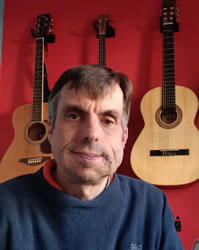
Omniglot is brought to you by me, Simon Ager (that's me in the photo). I started putting the site together in 1998 and have maintained and developed it since then. In 2008 Omniglot became a limited company and is now my main source of income. Many other people have made contributions of new material, corrections and suggestions, for which I'm profoundly grateful.
About this site | Omniglot - a potted history | About me | My language learning adventures | My musical adventures | My singing adventures | Song writing | Tunesmithing | My juggling adventures
[top]
I speak English, French, Welsh, Mandarin, and Irish (Gaelic) more or less fluently, and Scottish Gaelic, Manx (Gaelic), German, Spanish, Japanese and Esperanto fairly well.
I've studied quite a bit of Czech, Danish, Dutch, Russian and Swedish.
I've learnt the basics of Taiwanese, Cantonese, Italian, Portuguese, Breton, Faroese, Icelandic, Slovak, Slovenian, Serbian, Romanian, Cornish, Scots and British Sign Language (BSL).
I also know bits and pieces of Hindi, Toki Pona, Turkish, Arabic and Latin.
I studied French and German in secondary school, and did a BA in Chinese and Japanese at university. I've also taken short courses in Welsh and Irish, and courses in Scottish Gaelic songs. All the other languages I've taught myself.
More details of my language learning adventures.
About this site | Omniglot - a potted history | About me | My language learning adventures | My musical adventures | My singing adventures | Song writing | Tunesmithing | My juggling adventures
[top]
[top]

Why not share this page:

If you like this site and find it useful, you can support it by making a donation via PayPal or Patreon, or by contributing in other ways. Omniglot is how I make my living.
Note: all links on this site to Amazon.com


Get a 30-day Free Trial of Amazon Prime (UK)
If you're looking for home or car insurance in the UK, why not try Policy Expert?
[top]


