
The images below illustrates how a number of Chinese characters have changed over time from their earliest known pictographic forms, to the versions used today.
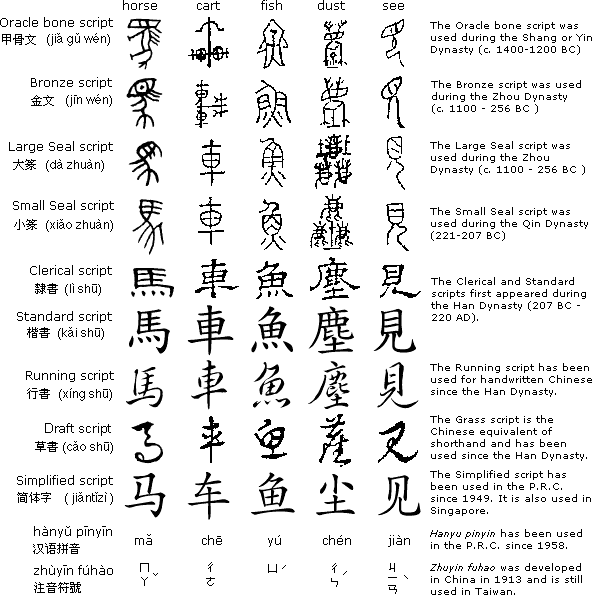
The Large Seal and Small Seal scripts are still used to write names on personal name chops, and are also occasionally used to write company names on buildings, stationery, namecards, etc.
The Draft or cursive script (草書) is used mainly for Chinese calligraphy. This script can be written very quickly and uses a number of method to achieve this: omitting part of a character, merging strokes together, replacing portions with abbreviated forms (such as one stroke to replace four dots), or modifying stroke style.
The Simplified script (a.k.a. Simplified Chinese), was officially adopted in the People's Republic of China in 1949 in an effort to eradicate illiteracy. It is also used in Singapore.
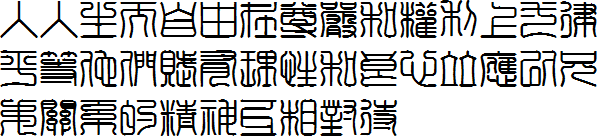
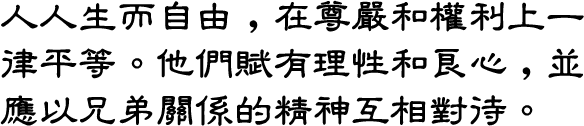
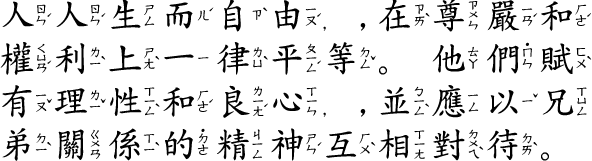
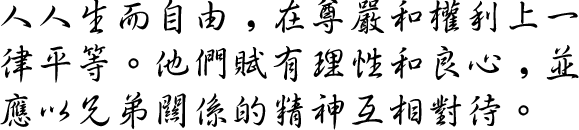

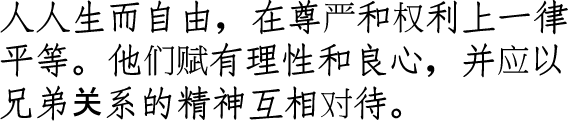
Rénrén shēng ér zìyóu, zài zūnyán hé quánlì shàng yīlǜ píngděng. Tāmen fùyǒu lǐxìng hé liángxīn, bìng yīng yǐ xīongdì guānxì de jīngshén hùxiāng duìdài.
All human beings are born free and equal in dignity and rights. They are endowed with
reason and conscience and should act towards one another in a spirit of brotherhood.
(Article 1 of the Universal Declaration of Human Rights)
Further information about the Chinese script

Books about Chinese characters and calligraphy
Mandarin, Shanghainese, Hokkien, Taiwanese and
Cantonese
language learning materials
Written Chinese: Oracle Bone Script, Simplified characters, Bopomofo, Types of characters, Structure of written Chinese, Evolution of characters, How the Chinese script works, Xiao'erjing, General Chinese
Spoken Chinese: Mandarin, Dungan, Wu, Shanghainese, Wenzhounese, Yue, Cantonese, Weitou, Min, Jian'ou, Taiwanese, Teochew, Fuzhounese, Puxian, Hakka, Xiang, Gan, How many people speak Chinese?
Other Chinese pages: Chinese numbers (數碼) | Chinese classifiers (量詞) | Electronic dictionaries | Chinese links | Books: Chinese characters and calligraphy | Cantonese | Mandarin, Shanghainese, Hokkien and Taiwanese
Akkadian Cuneiform, Ancient Egyptian (Demotic), Ancient Egyptian (Hieratic), Ancient Egyptian (Hieroglyphs), Chinese, Chữ-nôm, Cuneiform, Japanese, Jurchen, Khitan, Linear B, Luwian, Mayan, Naxi, Sawndip (Old Zhuang), Sui, Sumerian Cuneiform, Tangut (Hsihsia)
Page last modified: 15.03.23
[top]

You can support this site by Buying Me A Coffee, and if you like what you see on this page, you can use the buttons below to share it with people you know.

If you like this site and find it useful, you can support it by making a donation via PayPal or Patreon, or by contributing in other ways. Omniglot is how I make my living.
Note: all links on this site to Amazon.com


[top]


