
The Latin alphabet was first used in Japan in the 16th century by Portuguese missionaries, who devised a romanisation system based on Portuguese spelling. Later the Dutch introduced a romanisation system based on Dutch.
By the 20th century, there were a number of different romanisation systems in use, including the Nippon, Kunrei and Hepburn systems.
The Hepburn system was devised by James Curtis Hepburn (1815-1911), an American missionary from Philadelphia who arrived in Japan in 1859 and compiled the first modern Japanese-English dictionary about a decade later. The Hepburn system is now the most widely used romanisation system.
The Kunrei system was promulgated by the Japanese government during the 1930s. A revised version was issued in 1954.
The main differences in spelling between the Kunrei and Hepburn systems are as follows (Hepburn in brackets): si (shi), ti (chi), tu (tsu), hu (fu), zi (ji), sya (sha), syu (shu), syo (sho), tya (cha), tyu (chu), tyo (cho), zya (ja), zyu (ju), and zyo (jo). Long vowels: â (ā), ê (ē), î (ī), ô (ō), û (ū).
The Nippon system was the creation of Tanakadate Aikitsu and was first used in 1881. It is identical to the Kunrei system except for the sounds da, di, du, de, do, dya, dyu, dyo, which are written da, zi, zu, de, do, zya, zyu, zyo in the Kunrei system and da, ji, zu, de, do, ja, ju, jo in the Hepburn system.
This chart shows the Hepburn System of romanization with hiragana (on the left) and katakana (on the right), and the pronunciation in the IPA.
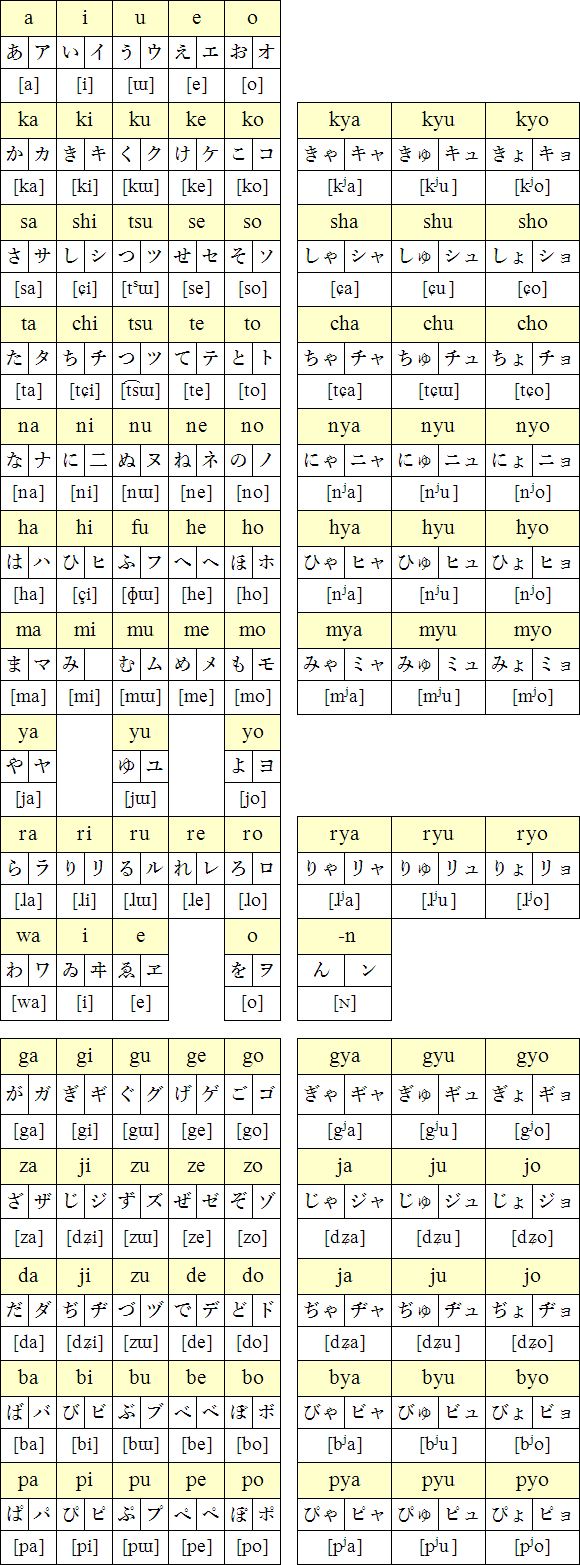
The symbols for i and e in the wa row are not used in modern Japanese.
Rōmaji is the standard way of transliterating Japanese into the Latin alphabet. In everyday written Japanese, rōmaji can be used to write numbers and abbreviations. It is also used in dictionaries, text books and phrase books for foreign learners of Japanese.
When typing Japanese on computers, most people, both Japanese and non-Japanese, use rōmaji, which is converted to kanji, hiragana or katakana by the input software. It is also possible to type in hiragana or katakana if you have a Japanese keyboard, but few people are familiar with this method.
Subete no ningen wa, umarenagara ni shite jiyū de ari, katsu, songen to kenri to ni tsuite byōdō de aru. Ningen wa, risei to ryōshin to o sazukerarete ori, tagai ni dōhō no seishin o motte kōdō shinakereba naranai.

All human beings are born free and equal in dignity and rights. They are endowed with reason
and conscience and should act towards one another in a spirit of brotherhood.
(Article 1 of the Universal Declaration of Human Rights)
ローマ字資料室
- information about the various rōmaji systems (in Japanese)
http://www.halcat.com/roomazi/doc/
Total Quality Japanese: The Romaji Conundrum (the source of some of the information on this page): http://www.cic.sfu.ca/tqj/JapaneseStudy/romaji.html
Information about Romaji
https://en.wikipedia.org/wiki/Romanization_of_Japanese
http://japanese-lesson.com/characters/romaji/index.html
Introduction to Japanese | Hiragana | Katakana | Kanji | Rōmaji | Phrases (Useful) | Phrases (Silly) | Numbers | Colours | Time | Dates | Family words | Tower of Babel | Articles | Links | Learning materials

Japanese courses and other resources on Amazon
- Find Japanese Tutors with LanguaTalk
Amami, Japanese, Kikai, Miyakoan, Okinawan, Okinoerabu, Tarama, Tokunoshima, Yaeyama, Yonaguni, Yoron
Akkadian Cuneiform, Ancient Egyptian (Demotic), Ancient Egyptian (Hieratic), Ancient Egyptian (Hieroglyphs), Chinese, Chữ-nôm, Cuneiform, Japanese, Jurchen, Khitan, Linear B, Luwian, Mayan, Naxi, Sawndip (Old Zhuang), Sui, Sumerian Cuneiform, Tangut (Hsihsia)
Page last modified: 15.03.23
[top]

You can support this site by Buying Me A Coffee, and if you like what you see on this page, you can use the buttons below to share it with people you know.

If you like this site and find it useful, you can support it by making a donation via PayPal or Patreon, or by contributing in other ways. Omniglot is how I make my living.
Note: all links on this site to Amazon.com


[top]


