
German is a West Germanic language spoken mainly in Germany, Austria, Switzerland, Liechtenstein, Belgium, Luxembourg and Italy. It is recognised as a minority language in Czech Republic, Denmark, Hungary, Kazakhstan, Ukraine, Namibia, Poland, Romania, Russia, Slovakia, Slovenia, Croatia, Serbia, South Africa, Vatican City and Venezuela. There are also significant German-speaking communities in the USA, Canada, Brazil, Argentina, Mexico, Australia, South Africa, Chile, Paraguay, New Zealand and Peru.
Standard German (Hochdeutsch) has around 90 million native speakers, and other varieties of German have some 30 million. There are about 80 million people who speak German as a second language, and many others study it as a foreign language.
The earliest known examples of written German date from the 8th century AD and consist of fragments of an epic poem, the Song of Hildebrand, magical charms and German glosses in Latin manuscripts. A short Latin-German dictionary, the Abrogans, was written during the 760s.
German literature started to take off during the 12th and 13th centuries in the form of poems, epics and romances. Well-known examples include the epic Nibelungenlied (the Song of the Nibelungs) and Gottfried von Straßburg's Tristan. The language used is now known as mittelhochdeutsche Dichtersprache (Middle High German poetic language). During this period Latin was gradually replaced by German as the language of official documents.
High German began to emerge as the standard literary language during the 16th century. Martin Luther's translation of the Bible, which he completed in 1534, marks the beginning of this process. The language he used, based partly on spoken German, became the model for written German.
A variety of German spoken by about 4 million people in Switzerland, occasionally appears in writing in novels, newspapers, personal letters and diaries.
Pennsylvania Dutch is a variety of German spoken by about 250,000 mainly in Pennsylvania, Ohio and Indiana in the USA, and in Ontario in Canada. The Pennsylvania Dutch newspaper Hiwwe wie Driwwe publishes poetry and prose in Pennsylvania Dutch, and there are a number of other publications featuring the language. Pennsylvania German is commonly referred to as Pennsylvania Dutch, however it is not a variety of Dutch.
Regional varities of German, or Mundarten, also occasionally appear in writing; mainly in 'folk' literature and comic books such as Asterix.
Sütterlin was created by the Berlin graphic artist L. Sütterlin (1865-1917), who modelled it on the style of handwriting used in the old German Chancery. It was taught in German schools from 1915 to 1941 and is still used by the older generation.
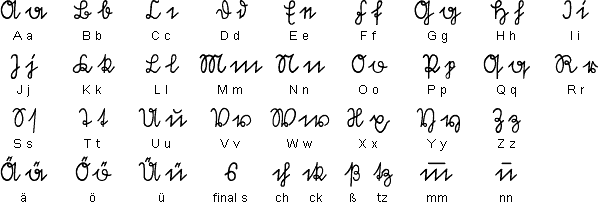

Download a font for Sütterlin (TrueType, 56K)
Archaic Latin alphabet, Basque-style lettering, Carolingian Minuscule, Classical Latin alphabet, Fraktur, Gaelic script, Merovingian, Modern Latin alphabet, Roman Cursive, Rustic Capitals, Old English, Sütterlin, Visigothic Script
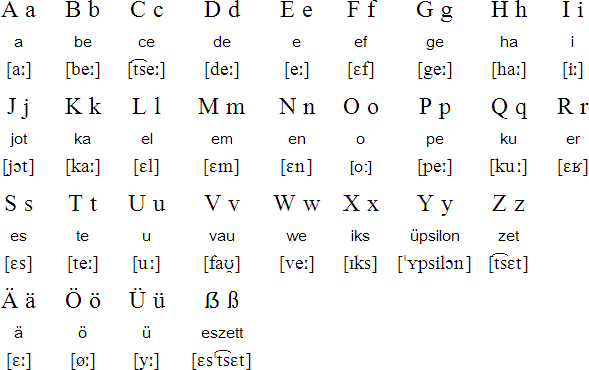
Hear the German alphabet with example words:
Source: https://en.wikipedia.org/wiki/German_orthography#Alphabet
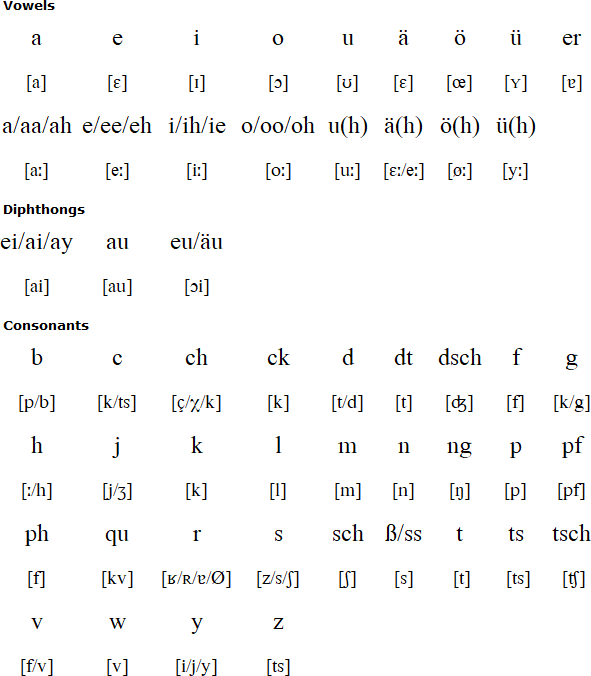
Hear how to pronounce German:
Download an alphabet chart for German (Excel)
Alle Menschen sind frei und gleich an Würde und Rechten geboren. Sie sind mit Vernunft und Gewissen begabt und sollen einander im Geist der Brüderlichkeit begegnen.
All human beings are born free and equal in dignity and rights. They are endowed with reason and conscience and should act towards one another in a spirit of brotherhood.
(Article 1 of the Universal Declaration of Human Rights)
Information about German | Fraktur script | Useful phrases | Silly phrases | Numbers | Colours | Family words | Time | Weather | Tongue twisters | Tower of Babel | Articles | Links | Learning materials
Find German Tutors, Teachers and Lesson Help
Information about the German language
http://www.lowlands-l.net/anniversary/deutsch-info.php
http://en.wikipedia.org/wiki/German_language
https://www.clozemaster.com/blog/topics/language-learning/learn-german/
https://www.howtolearnalanguage.info/languages/german/alphabet
Online German courses
http://www.bbc.co.uk/languages/german/
http://www.deutsch-lernen.com
http://www.deutschakademie.de/online-deutschkurs/english/
http://www.deutsched.com
http://www.yesgerman.com/
http://learn-german-easily.com
http://leicht-deutsch-lernen.com
http://polymath.org/german.php
http://ilovelanguages.org/german.php
http://ablogaboutlanguages.blogspot.co.uk/p/free-german-lessons-overview.html
http://www.studying-in-germany.org/learn-german/
http://www.hit-tuner.net/de/podcast/deutsch_lernen.html
https://www.lingoda.com/en/german/learning-material/cefr/A1.1
https://besser-deutsch.com/
http://www.germanpod101.com/
Afrikaans, Alsatian, Bavarian, Cimbrian, Danish, Dutch, Elfdalian, English, Faroese, Flemish, Frisian (East), Frisian (North), Frisian (Saterland), Frisian (West), German, Gothic, Gottscheerish, Gronings, Hunsrik, Icelandic, Limburgish, Low German, Luxembourgish, Mòcheno, Norn, Norwegian, Old English, Old Norse, Pennsylvania German, Ripuarian, Scots, Shetland(ic), Stellingwarfs, Swabian, Swedish, Swiss German, Transylvanian Saxon, Värmlandic, Wymysorys, Yiddish, Yola, Zeelandic
Languages written with the Latin alphabet
Page last modified: 26.04.22
[top]

Note: all links on this site to Amazon.com


You can support this site by Buying Me A Coffee, via PayPal or Patreon, or by contributing in other ways.
If you find all the adverts annoying, there is now an Ad-free version of Omniglot which you can access for a small monthly or annual donation.

This website and its content is copyright of Simon Ager - © Simon Ager 1998-2026. All rights reserved. All images were created by me, unless otherwise indicated. More details

[top]


