
Afrikaans is a Low Franconian West Germanic language descended from Dutch and spoken mainly in South Africa and Namibia. In 2013 there were about 17 million speakers in South Africa, where Afrikaans is one of the Statutory national languages, and an official language in nine provinces. About 6.8 million of those people are native speakers of Afrikaans, while the rest speak it as a second language.
In Namibia there were 127,000 speakers of Afrikaans in 2018, mainly in the Hardap and Khomas regions in the south of the country. It is used in schools and is officially recognized.
Other countries with significant numbers of Afrikaans speakers include Zamnbia (96,000), Australia (43,700), New Zealand (27,400), the USA (23,000), Eswatini (17,000) and the Netherlands (14,300) {source].
Afrikaans retains some features of 18th century Dutch, together with vocabulary from various Bantu and Khoisan languages and also from Portugese and Malay. Afrikaans and Dutch are more or less mutually intelligible.
Here is an example of Dutch speakers trying to understand Afrikaans.
From about 1815 Afrikaans started to replace Malay as the language of instruction in Muslim schools in South Africa. At that time it was written with the Arabic alphabet.
Afrikaans, written with the Latin alphabet, started to appeared in newspapers and political and religious works in about 1850. Then in 1875 a group of Afrikaans speakers from the Cape formed the Genootskap vir Regte Afrikaanders (Society for Real Afrikaners), and published a number of books in Afrikaans, including grammars, dictionaries, religious material and histories. They also published a journal called the Patriot.
During the early years of the 20th century there was a blossoming of academic interest in Afrikaans. In 1925 Afrikaans was recognised by the government as a real language, instead of a slang version of Dutch. Afrikaans has changed little since then.
| A a | B b | C c | D d | E e | F f | G g | H h | I i |
|---|---|---|---|---|---|---|---|---|
| aa | bee | see | dee | ee | ef | gee | haa | ie |
| J j | K k | L l | M m | N n | O o | P p | Q q | R r |
| jee | kaa | el | em | en | oo | pee | kuu | er |
| S s | T t | U u | V v | W w | X x | Y y | Z z | |
| es | tee | uu | vee | wee | ex | y | set |
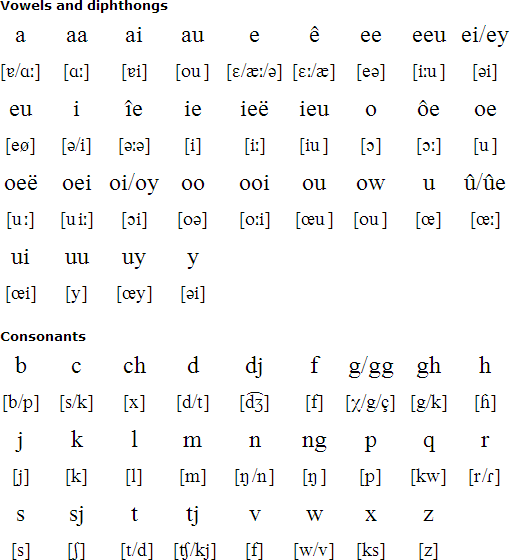
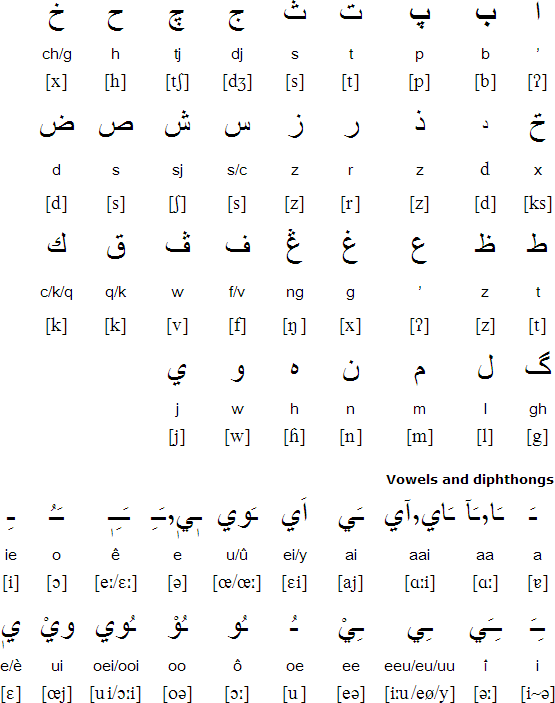
Download Afrikaans alphabet charts (Excel)

Details of the Arabic alphabet for Afrikaans and the sample text in the Arabic alphabet supplied by Michael Peter Füstumum
Alle menslike wesens word vry, met gelyke waardigheid en regte, gebore. Hulle het rede en gewete en behoort in die gees van broederskap teenoor mekaar op te tree.
Hear a recording of this text by Marius Kock
All human beings are born free and equal in dignity and rights. They are endowed with reason and conscience and should act towards one another in a spirit of brotherhood.
(Article 1 of the Universal Declaration of Human Rights)
See more videos like this on Wikitongues
Information about Afrikaans | Phrases | Numbers | Family words | Time | Tower of Babel | Afrikaans courses on: Amazon.com and Amazon.co.uk [affilate links]
Learn Afrikaans online with AfrikaansPod101
Afrikaans courses and other resources available on Amazon
Information about Afrikaans
http://en.wikipedia.org/wiki/Afrikaans
http://ar.wikipedia.org/wiki/كتابة_عربية_أفريقانية
http://www.lowlands-l.net/anniversary/afrikaans-intro.php
https://aie.ned.univie.ac.at
http://www.dwc.knaw.nl/DL/publications/PU00009791.pdf
Online Afrikaans lessons
https://easyafrikaans.com/
http://polymath.org/afrikaans.php
http://www.mylanguages.org/learn_afrikaans.php
https://www.lingohut.com/en/l110/learn-afrikaans
http://www.afrikaanspod101.com
Hear the sounds of the Arikaans alphabet
http://www.sois.uwm.edu/afrikaans/pronunciation/alphabet.html
Afrikaans and Dutch humour newsletter
http://grappies.com
Afrikaans phrases
http://www.exploresouthafrica.net/phrasebook.htm
http://www.downloadalanguage.com/downloadalanguage/Afrikaans_phrases.html
http://www.easyafrikaans.com/easyafrikaans/Useful_Phrases.html
http://miejipang.homestead.com/untitled4.html
Online Afrikaans dictionaries
http://www.freelang.net/online/afrikaans.php
https://rieme.co.za
https://www.majstro.com/woordeboeke/Engels-Afrikaans
https://www.woordeboek.co.za/
https://www.lexilogos.com/english/afrikaans_dictionary.htm
Online Afrikaans Radio
http://www.rsg.co.za/
Online news Afrikaans
http://www.volksblad.com
http://www.rapport.co.za
http://www.dieburger.com
http://maroelamedia.co.za
http://www.beeld.com/
Afrikaans, Alsatian, Bavarian, Cimbrian, Danish, Dutch, Elfdalian, English, Faroese, Flemish, Frisian (East), Frisian (North), Frisian (Saterland), Frisian (West), German, Gothic, Gottscheerish, Gronings, Hunsrik, Icelandic, Limburgish, Low German, Luxembourgish, Mòcheno, Norn, Norwegian, Old English, Old Norse, Pennsylvania German, Ripuarian, Scots, Shetland(ic), Stellingwarfs, Swabian, Swedish, Swiss German, Transylvanian Saxon, Värmlandic, Wymysorys, Yiddish, Yola, Zeelandic
Adamaua Fulfulde, Aer, Afrikaans, Arabic (Algerian), Arabic (Bedawi), Arabic (Chadian), Arabic (Egyptian), Arabic (Gulf), Arabic (Hassaniya), Arabic (Hejazi), Arabic (Lebanese), Arabic (Libyan), Arabic (Modern Standard), Arabic (Moroccan), Arabic (Najdi), Arabic (Sudanese), Arabic (Syrian), Arabic (Tunisian), Arwi, Äynu, Azeri, Balanta-Ganja, Balti, Baluchi, Beja, Belarusian, Bosnian, Brahui, Chagatai, Chechen, Chittagonian, Comorian, Crimean Tatar, Dameli, Dargwa, Dari, Dhatki, Dogri, Domari, Gawar Bati, Gawri, Gilaki, Hausa, Hazaragi, Hindko, Humburi Senni, Indus Kohistani, Kabyle, Kalkoti, Karachay-Balkar, Karakalpak, Kashmiri, Katë, Kazakh, Khowar, Khorasani Turkic, Khwarezmian, Konkani, Kumzari, Kurdish, Kyrgyz, Lezgi, Lop, Luri, Maasina Fulfulde, Maba, Maguindanao, Malay, Malay (Terengganu), Mandinka, Marwari, Mazandarani, Mogholi, Morisco, Mozarabic, Munji, Noakhailla, Nubi, Ormuri, Palula, Parkari Koli, Pashto, Persian/Farsi, Punjabi, Qashqai, Rajasthani, Rohingya, Salar, Saraiki, Sawi, Serer, Shabaki, Shina, Shughni, Sindhi, Somali, Soninke, Tatar, Tausūg, Tawallammat Tamajaq, Tayart Tamajeq, Ternate, Torwali, Turkish, Urdu, Ushoji, Uyghur, Uzbek, Wakhi, Wanetsi, Wolof, Xiao'erjing, Yidgha
Languages written with the Latin alphabet
Page last modified: 26.06.25
[top]

You can support this site by Buying Me A Coffee, and if you like what you see on this page, you can use the buttons below to share it with people you know.

If you like this site and find it useful, you can support it by making a donation via PayPal or Patreon, or by contributing in other ways. Omniglot is how I make my living.

Note: all links on this site to Amazon.com

[top]


