
Yao is a Bantu language spoken by about 3 million people in Malawi, Tanzania and Mozambique, and also in Zambia. The main dialect in Malawi, Mangoche, is spoken around Lake Malawi, particularly around the southeast tip of the lake. The main dialects in Mozambique are known as Makale and Massaninga, and most Yao speakers live in Niassa Province. The majority of speakers in Tanzania are found east of Lake Malawi in the Mtwara and Ruvuma Regions.
Yao is also known as chiYao, ciYao, Achawa, Adsawa, Adsoa, Ajawa, Ayawa, Ayo, Ayao, Djao, Haiao, Hiao, Hyao, Jao, Veiao or waJa.
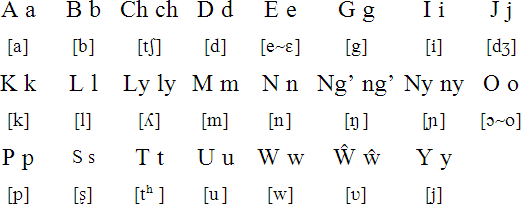
This is the spelling system used in Malawi, which is based on Chichewa. The orthography used in Tanzania is based on Swahili.
Wandu wosope akasapagwa ni ufulu ni uchimbichimbi wakulandana. Asapagwa ni lunda, niwakupakombola ganisya, m'yoyo kukusosekwa kuti mundu jwalijose am'woneje mundu jwimwe mpela mlongomjakwe.
All human beings are born free and equal in dignity and rights. They are endowed with reason and conscience and should act towards one another in a spirit of brotherhood.
(Article 1 of the Universal Declaration of Human Rights)
Information about Yao | Numbers | Tower of Babel
Information about the Yao language
https://en.wikipedia.org/wiki/Yao_language
http://www.ethnologue.com/language/yao
Aka, Aushi, Bafaw-Balong, Bangi, Bangubangu, Basaa, Bemba, Bembe, Bena, Benga, Bhaca, Bila, Bube, Budu, Bujeba, Bukusu, Bulu, Bushong, Central Kilimanjaro, Central Teke, Chichewa, Chokwe, Chopi, Chuwabu, Comorian, Dciriku, Digo, Duala, Eton, Ewondo, Fang, Fuliiru, Fwe, Ganda/Luganda, Giryama, Gogo, Gungu, Gusii, Gwere, Gyele, Ha, Haya, Hehe, Herero, Ibinda, Idaxo-Isuxa-Tiriki, Ikizu, Ikoma, Jita, Kabwa, Kako, Kalanga, Kamba, Kanyok, Kgalagadi, Kiga, Kikuyu, Kimbundu, Kinyarwanda, Kirundi, Kisi, Kobo, Kogo, Komo, Kongo, Konjo, Koti, Kuhane, Kukuya, Kunda, Kuria, Kwambi, Kwangali, Kwasio, Lambya, Lega, Lengola, Lingala, Loma, Lomwe, Lozi, Luba-Katanga, Luchazi, Lunda, Luvale, Luyana, Makaa, Makonde, Makhuwa, Mandekan, Maore, Masaaba, Mbama, Mbere, Mbosi, Mbugu, Mbukushu, Mbunda, Mbuun, Mende, Mongo, Mpiemo, Mushungulu, Mwani, Myene, Nambya, Nande, Ndau, Ndonga, Ngoni, Ngwii, Njebi, Nkore, North Teke, Northern Ndebele (South Africa), Northern Ndebele (Zimbabwe), Northern Sotho, Nyamwezi, Nyakyusa, Nyemba, Nyole, Nyoro, Nyungwe, Nzadi, Oroko, OshiWambo, Pagibete, Pare, Phuthi, Punu, Rangi, Ronga, Safwa, Seki, Sena, Sengele, Shambala, Shi, Shona, Soga, Songe, Southern Ndebele, Southern Sotho, Suba, Sukuma, Swahili, Swati, Taita, Talinga, Tanga, Tembo, Tetela, Tonga, Tongwe, Tooro, Tshiluba, Tsonga, Tswa, Tswana, Tumbuka, Turu, Umbundu, Venda, Vili, Vwanji, Wanzi, West Teke, Xhosa, Yakam, Yansi, Yao, Yasa, Yeyi, Zigula, Zinza, Zulu
Languages written with the Latin alphabet
Page last modified: 05.03.23
[top]

Note: all links on this site to Amazon.com


You can support this site by Buying Me A Coffee, via PayPal or Patreon, or by contributing in other ways.
If you find all the adverts annoying, there is now an Ad-free version of Omniglot which you can access for a small monthly or annual donation.

This website and its content is copyright of Simon Ager - © Simon Ager 1998-2026. All rights reserved. All images were created by me, unless otherwise indicated. More details

[top]


