
Tocharian is an extinct branch of the Indo-European language family which was spoken in oases on the northern edge of the Tarim Basin, an area which is now part of Xinjiang Uyghur Autonomous Region in China. Fragments of manuscripts and other writing in the Tocharian script dating from between the 6th and 8th centuries AD were discovered there in the early 20th century.
When the alphabet was deciphered, it was discovered that it represented two previously unknown languages which were dubbed Tocharian A, or East Tocharian, Agnean or Turfanian, and Tocharian B, or West Tocharian or Kuchean. Tocharian A appears more archaic and was used a liturgical language, while Tocharian B was spoken around Turfan and Tumshuq. The languages disappeared after Uyghur-speaking people settled in the area during the 9th century.
The Tocharian alphabet was derived from the Brahmi alphabet. It was written on palm, wooden tablets and Chinese paper, which were preserved in the dry climate of the Tarim Basin. Some inscriptions on mural have also been found.
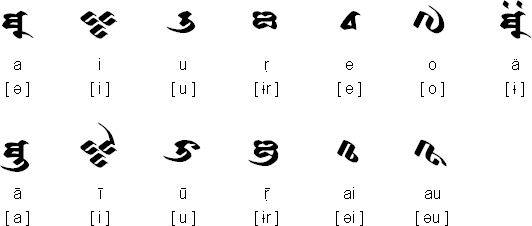
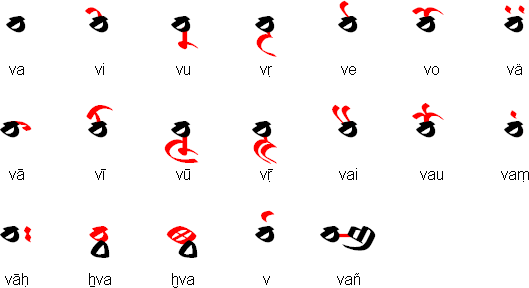
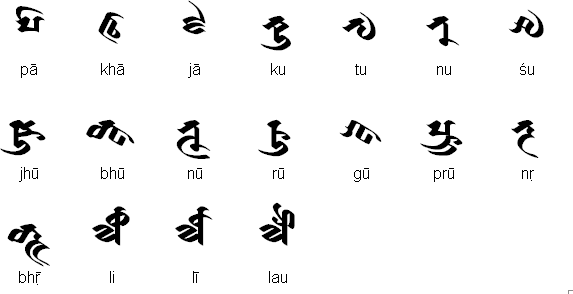
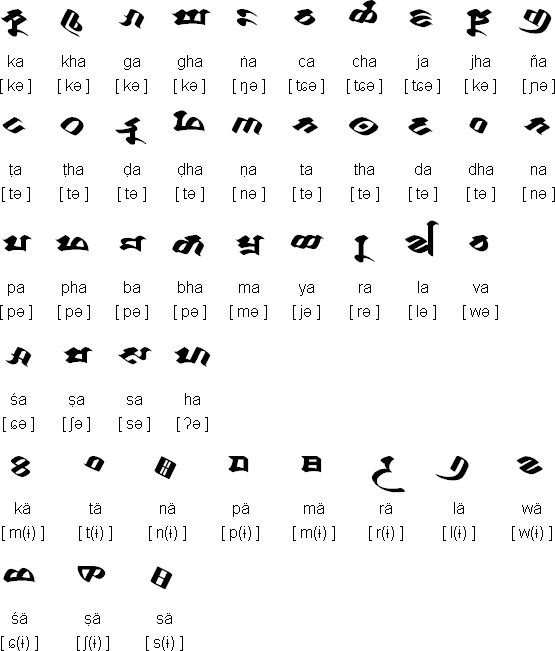
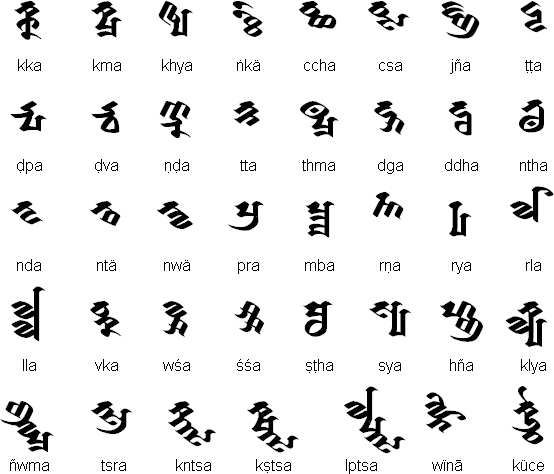
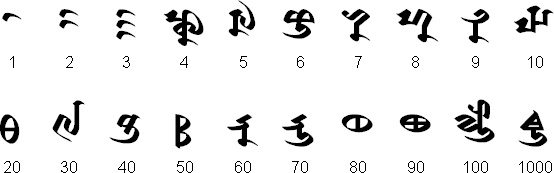
Tocharian alphabet images provided by Lee Wilson
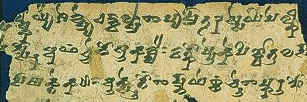
Poñc śāmna perimeṃ tsälpālñesa ṣpä ṣemeyärm yarkene ṣpä plākiṃne tämeṃ. Ālambaṃ ṣpä kärsor truknāntärme, ṣpä klinaṣṣäṃ alyauce ra proceri spārtti.
Translation by Aram Neresian
All human beings are born free and equal in dignity and rights. They are endowed with reason and conscience and should act towards one another in a spirit of brotherhood.
(Article 1 of the Universal Declaration of Human Rights)
Information about Tocharian
http://en.wikipedia.org/wiki/Tocharian_languages
http://en.wikipedia.org/wiki/Tocharian_script
http://titus.fkidg1.uni-frankfurt.de/didact/idg/toch/tochbr.htm
Images of Tocharian Manuscripts
http://titus.uni-frankfurt.de/texte/tocharic
Ahom, Aima, Arleng, Badagu, Badlit, Basahan, Balinese, Balti-A, Balti-B, Batak, Baybayin, Bengali, Bhaiksuki, Bhujimol, Bilang-bilang, Bima, Blackfoot, Brahmi, Buhid, Burmese, Carrier, Chakma, Cham, Cree, Dehong Dai, Devanagari, Dham Lipi, Dhankari / Sirmauri, Ditema, Dives Akuru, Dogra, Ethiopic, Evēla Akuru, Fox, Fraser, Gond, Goykanadi, Grantha, Gujarati, Gunjala Gondi, Gupta, Gurmukhi, Halbi Lipi, Hanifi, Hanuno'o, Hočąk, Ibalnan, Incung, Inuktitut, Jaunsari Takri, Javanese, Kaithi, Kadamba, Kamarupi, Kannada, Kawi, Kharosthi, Khema, Khe Prih, Khmer, Khojki, Khudabadi, Kirat Rai, Kōchi, Komering, Kulitan, Kurukh Banna, Lampung, Lanna, Lao, Lepcha, Limbu, Lontara/Makasar, Lota Ende, Magar Akkha, Mahajani, Malayalam, Meitei (Modern), Manpuri (Old), Marchen, Meetei Yelhou Mayek, Meroïtic, Masarm Gondi, Modi, Mon, Mongolian Horizontal Square Script, Multani, Nandinagari, Newa, New Tai Lue, Ojibwe, Odia, Ogan, Pahawh Hmong, Pallava, Phags-pa, Purva Licchavi, Qiang / Rma, Ranjana, Rejang (Kaganga), Sasak, Savara, Satera Jontal, Shan, Sharda, Siddham, Sinhala, Sorang Sompeng, Sourashtra, Soyombo, Sukhothai, Sundanese, Syloti Nagri, Tagbanwa, Takri, Tamil, Tanchangya (Ka-Pat), Tani, Thaana, Telugu, Thai, Tibetan, Tigalari, Tikamuli, Tocharian, Tolong Siki, Vatteluttu, Warang Citi
Page last modified: 16.03.23
[top]

Why not share this page:

If you like this site and find it useful, you can support it by making a donation via PayPal or Patreon, or by contributing in other ways. Omniglot is how I make my living.
Note: all links on this site to Amazon.com


Get a 30-day Free Trial of Amazon Prime (UK)
If you're looking for home or car insurance in the UK, why not try Policy Expert?
[top]


