

The Lontara script is descended from the Brahmi script of ancient India. The name lontara derives from the Malay word for the palmyra palm, lontar, the leaves of which are the traditional material for manuscripts in India, South East Asia and Indonesia.
Bugis or Buginese (Basa Ugi / ᨅᨔ ᨕᨘᨁᨗ), Makassarese (ᨅᨔ ᨆᨀᨔᨑ) and Mandar, Austronesian languages spoken on the Indonesian island of Sulawesi.
This script was once used to write laws, treaties, maps, etc in Bugis, but is now only used for marriage ceremonies. Makassarese (ᨅᨔ ᨆᨀᨔᨑ / Basa Mangkasara'), is still written with this script, although the Latin alphabet is officially favoured.
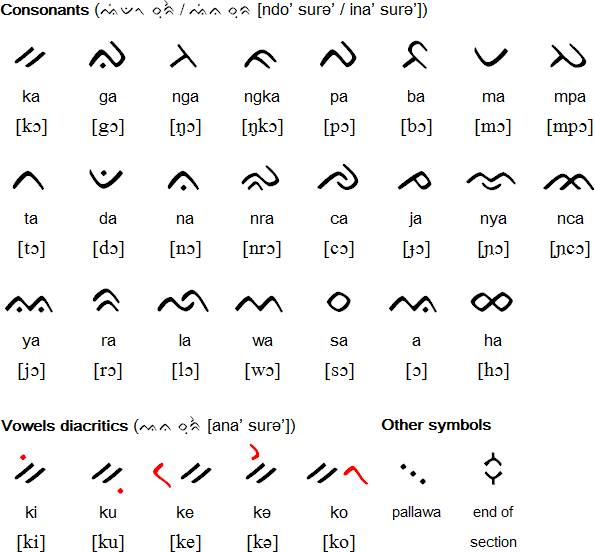
The pallawa is used to separate rhythmico-intonational groups, and has a similar function to the fullstop and comma. It can also be used to denote the doubling of a word or its root.
Download an alphabet chart for Bugis (Excel)
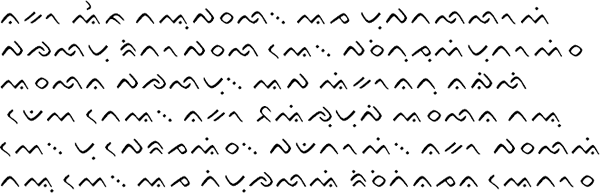
nako əŋka taupasala. aja mupatalalowi pacalamu ritopasalae. pasitujuwimutowisa asalana pacalamu. apa ikonatu nagili dewatea. nako baicumupi asalana tauwe. muperajaisa. padatowi. nako pasalai tauwe. aja timucalai risitinajanaetosa asalana.
If you deal with a person guilty of something, do not punish him too harshly. Always make the punishment commensurable with the guilt, since God will be angry with you if the person's guilt is not great and you are exaggerating it. Equally, if a person is guilty, do not let him go without a punishment in accordance with his guilt.
Source: http://en.wikipedia.org/wiki/Lontara_alphabet
Information about Bugis | Bilang-bilang script | Numbers | Tower of Babel
Information about Lontara, Buginese and Makassarese
http://en.wikipedia.org/wiki/Lontara
http://en.wikipedia.org/wiki/Buginese_language
http://en.wikipedia.org/wiki/Makassarese_language
Lontara fonts
http://www.wazu.jp/gallery/Fonts_Buginese.html
http://alibataatpandesal.com/outbox.html
Languages written with the Latin alphabet
Ahom, Aima, Arleng, Badagu, Badlit, Basahan, Balinese, Balti-A, Balti-B, Batak, Baybayin, Bengali, Bhaiksuki, Bhujimol, Bilang-bilang, Bima, Blackfoot, Brahmi, Buhid, Burmese, Carrier, Chakma, Cham, Cree, Dehong Dai, Devanagari, Dham Lipi, Dhankari / Sirmauri, Ditema, Dives Akuru, Dogra, Ethiopic, Evēla Akuru, Fox, Fraser, Gond, Goykanadi, Grantha, Gujarati, Gunjala Gondi, Gupta, Gurmukhi, Halbi Lipi, Hanifi, Hanuno'o, Hočąk, Ibalnan, Incung, Inuktitut, Jaunsari Takri, Javanese, Kaithi, Kadamba, Kamarupi, Kannada, Kawi, Kharosthi, Khema, Khe Prih, Khmer, Khojki, Khudabadi, Kirat Rai, Kōchi, Komering, Kulitan, Kurukh Banna, Lampung, Lanna, Lao, Lepcha, Limbu, Lontara/Makasar, Lota Ende, Magar Akkha, Mahajani, Malayalam, Meitei (Modern), Manpuri (Old), Marchen, Meetei Yelhou Mayek, Meroïtic, Masarm Gondi, Modi, Mon, Mongolian Horizontal Square Script, Multani, Nandinagari, Newa, New Tai Lue, Ojibwe, Odia, Ogan, Pahawh Hmong, Pallava, Phags-pa, Purva Licchavi, Qiang / Rma, Ranjana, Rejang (Kaganga), Sasak, Savara, Satera Jontal, Shan, Sharda, Sheek Bakrii Saphaloo, Siddham, Sinhala, Sorang Sompeng, Sourashtra, Soyombo, Sukhothai, Sundanese, Syloti Nagri, Tagbanwa, Takri, Tamil, Tanchangya (Ka-Pat), Tani, Thaana, Telugu, Thai, Tibetan, Tigalari, Tikamuli, Tocharian, Tolong Siki, Vatteluttu, Warang Citi
Page last modified: 13.04.23
[top]

Why not share this page:

If you like this site and find it useful, you can support it by making a donation via PayPal or Patreon, or by contributing in other ways. Omniglot is how I make my living.
Note: all links on this site to Amazon.com


Get a 30-day Free Trial of Amazon Prime (UK)
[top]


