

Lao is a Tai-Kadai language spoken mainly in Laos, and also in Cambodia and Vietnam. In 2015 there were about 3.4 million native speakers of Lao in Laos, and another 800,000 people spoke it as a second language. In 2009 there were about 18,500 Lao speakers in northwest Cambodia, and there were 14,900 speakers in Vietnam.
Lao is closely related to Thai and speakers of Lao are able to understand spoken Thai without too many difficulties. Thai speakers find it more difficult to understand Lao due to lack of exposure to the language. The language family is also known as Kradai, Kra-Dai, Daic or Kadai.
After the unification of the Lao principalities (meuang) in the 14th century, the Lan Xang monarchs commissioned their scholars to create a new script to write the Lao language. The scholars probably modelled the alphabet on the Old Khmer script, which was itself based on Mon scripts.
The transcription system used here is one used by the British Permanent Committee on Geographical Names (BGN/PCGN).
Consonants are divided into three classes which help to determine the tone of a syllable (indicated by the numbers below). The sounds represented by some consonants change when they are used at the end of a syllable (indicated by the letters on the right of the slash below). The consonants can all be used at the beginning of a syllable but only some can be used at the end of a syllable.
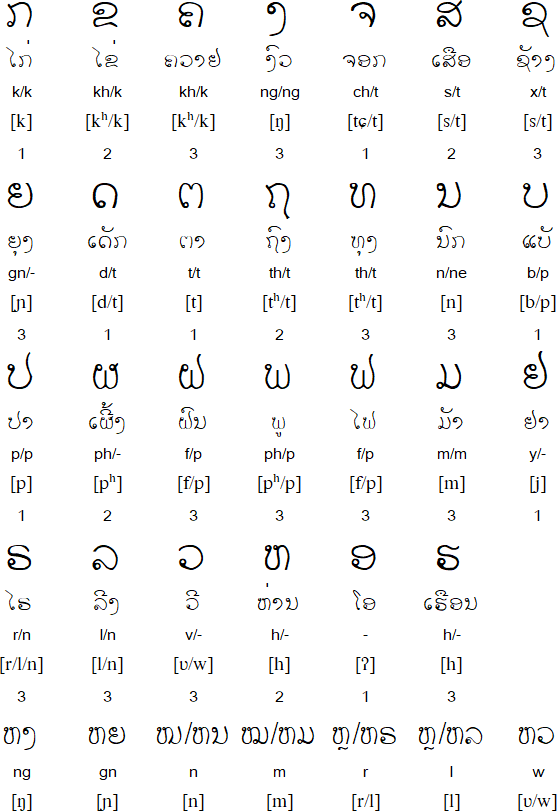
The consonants in the final row are compounds and conjuncts used as alternatives to the basic consonants.
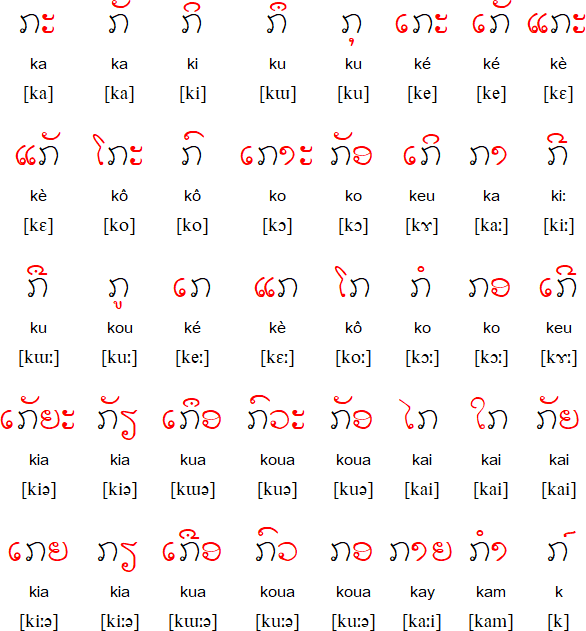
How to write and pronounce Lao letters

How to write and pronounce Lao numbers
| Open syllables | Closed syllables * | ||||
| unmarked |  |
 |
short vowel | long vowel | |
| Class 1 | low | mid | high falling | high | low falling |
| Class 2 | low rising | mid | low falling | high | low falling |
| Class 3 | high | mid | high falling | mid | high falling |
* Closed syllables are those ending with p, t or k
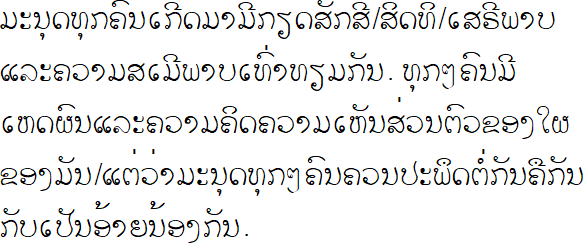
Transliteration
Manut thuk khôn kœ̄t māmīkẏat sâk sī, sitthi, sēlī phôp læ khwôm smœ̄ phôp thàw thẏam kân. Thuk thuk khôn mīhēt phôn læ khwômkhit khwôm hian swàn tôw khɔ̄̄ṅ phai khɔ̄ṅ mân, tǣ̀vồ manut thuk thuk khôn khwan paphʉt tàṁ kân khʉ̄ kân kâp pianốy nɔ̄́ṅ kân.
Hear a recording of this text (made with Text To Speech Free)
All human beings are born free and equal in dignity and rights. They are endowed with reason and conscience and should act towards one another in a spirit of brotherhood.
(Article 1 of the Universal Declaration of Human Rights)
Information about Lao | Phrases | Numbers | Family words | Tower of Babel | Learning materials
Information about Laos and the Laotian language
http://en.wikipedia.org/wiki/Lao_language
http://www.seasite.niu.edu/lao/laolanguage/lao_language_fp.htm
Online Lao lessons
http://www.seasite.niu.edu/Lao/LaoLanguage/spoken_lao/spokenlao.htm
Lao phrases
http://wikitravel.org/en/Lao_phrasebook
http://www.phrasebook.thai-isan-lao.com
http://laos411.com/language/
Online Lao dictionaries
http://www.sealang.net/lao/dictionary.htm
http://glosbe.com/lo/en/
http://sengphachanh.webege.com/eng2lao.html
http://laodictionary.net
Free Lao fonts
http://www.wazu.jp/gallery/Fonts_Lao.html
http://www.laoscript.net/downloads/
http://www.seasite.niu.edu/seasite.htm#download
Online Lao news and radio
http://www.rfa.org/lao/
Ahom, Aiton, Bouyei, Isan, Khamti, (Tai) Khün, Lao, Lue, Northern Thai (Kam Mueang), Nùng, Shan, Tai Dam, Tai Dón, Tai Hongjin, Tai Laing, Tai Nuea, Tai Phake, Tai Ya, Tai Yo, Tày, Thai, Thai Song, Yang Zhuang, Zhuang
Katu, Khmu, Kuy, Lao, Pali, TaʼOi
Ahom, Aima, Arleng, Badagu, Badlit, Basahan, Balinese, Balti-A, Balti-B, Batak, Baybayin, Bengali, Bhaiksuki, Bhujimol, Bilang-bilang, Bima, Blackfoot, Brahmi, Buhid, Burmese, Carrier, Chakma, Cham, Cree, Dehong Dai, Devanagari, Dham Lipi, Dhankari / Sirmauri, Ditema, Dives Akuru, Dogra, Ethiopic, Evēla Akuru, Fox, Fraser, Gond, Goykanadi, Grantha, Gujarati, Gunjala Gondi, Gupta, Gurmukhi, Halbi Lipi, Hanifi, Hanuno'o, Hočąk, Ibalnan, Incung, Inuktitut, Jaunsari Takri, Javanese, Kaithi, Kadamba, Kamarupi, Kannada, Kawi, Kharosthi, Khema, Khe Prih, Khmer, Khojki, Khom Thai, Khudabadi, Kirat Rai, Kōchi, Kodava Lipi, Komering, Kulitan, Kurukh Banna, Lai Tay (Tai Yo), Lampung, Lanna, Lao, Leke, Lepcha, Limbu, Lontara/Makasar, Lota Ende, Magar Akkha, Mahajani, Malayalam, Meitei (Modern), Manpuri (Old), Marchen, Meetei Yelhou Mayek, Meroïtic, Masarm Gondi, Modi, Mon, Mongolian Horizontal Square Script, Multani, Nandinagari, Newa, New Tai Lue, Ojibwe, Odia, Ogan, Pahawh Hmong, Pallava, Phags-pa, Purva Licchavi, Qiang / Rma, Ranjana, Rejang (Kaganga), Sasak, Savara, Satera Jontal, Shan, Sharda, Sheek Bakrii Saphaloo, Siddham, Sinhala, Sorang Sompeng, Sourashtra, Soyombo, Sukhothai, Sundanese, Syloti Nagri, Tagbanwa, Tai Noi, Takri, Tamil, Tanchangya (Ka-Pat), Tani, Thaana, Telugu, Thai, Thirke, Tibetan, Tigalari, Tikamuli, Tocharian, Tolong Siki, Vatteluttu, Warang Citi
Page last modified: 14.04.24
[top]

Note: all links on this site to Amazon.com


You can support this site by Buying Me A Coffee, via PayPal or Patreon, or by contributing in other ways.
If you find all the adverts annoying, there is now an Ad-free version of Omniglot which you can access for a small monthly or annual donation.

This website and its content is copyright of Simon Ager - © Simon Ager 1998-2026. All rights reserved. All images were created by me, unless otherwise indicated. More details

[top]


