
Mwesen is a member of the North Vanuatu branch of the Southern Oceanic language family. It has about 10 speakers in the southeast of Vanua Lava Island, one of the Banks Islands in Torba Province in northern Vanuatu. It is classified as a moribund language as only adults speak it.
Mwesen is also known as Mosina. Both Mwesen and Mosina are versions of the name a village in eastern Vanua Lava where the language is spoken. Mwesen comes from M̄ēsēn [ŋmʷɪˈsɪn], the name of the village in Mwesen, while Mosina comes from M̄osina [ŋ͡mʷosina], the old name of the village in Mota, a language spoken on the nearby Mota Island. In modern Mota, the village is known as M̄osna [ŋ͡mʷosna].
Mwesen is closely related to Vurës, the main language spoken in Vanua Lava, and Mwesen speakers all speak Vurës. The two languages are classified as dialects of a single language in some sources.
A way to write Mwesen with the Latin alphabet was proposed in O gatle ta M̅ēsēn – The language of Mwesen, a literacy primer printed in 2004.
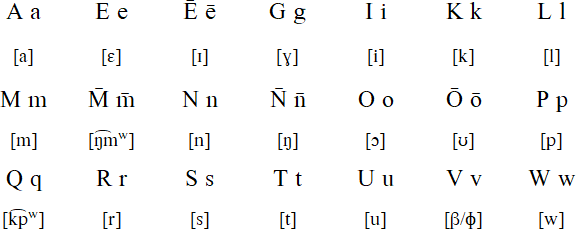
Download an alphabet chart for Mwesen (Excel)
E Qet, e ra testesen san̄wul nem̄e ni tawal. Nēr ga togtog Leseper. Qēt, e gonon e Qet mēlēn̄; o san e Rovilgal. Le qōn̄ ni tawal, nēr me togtog, e ra testesen e Qet me gat min nē ta: "Ee! Nin a van a tar ak?" E Qet wo: "Ga wē." Qēt, e rege no nēr a van pe tar ak, wo e Qet ni on ti le gemel. E rege me van, me tartar qēt o ak, mōl kēl me; a ēl e Qet ti on ti le gemel.
Kpwet had eleven brothers. They all lived in Leseper together with Kpwet's wife, Rovilgal. One day, as they were all together, Kpwet's brothers said to him: "Let's go and make canoes! - OK", said Kpwet. And off they went to make canoes; all but Kpwet, who preferred to lie in his dwelling. They finished their task and returned home. There they found Kpwet quietly resting in his dwelling.
Source: https://marama.huma-num.fr/AFtxt_msn-kpwet_e-3lgs.htm
Information about Mwesen
https://en.wikipedia.org/wiki/Mwesen_language
https://marama.huma-num.fr/AFtxt_msn-kpwet_e-3lgs.htm
https://pangloss.cnrs.fr/corpus/Mwesen
Adzera, Ahamb, Äiwoo, Aneityum, Apma, Araki, Are, ʼAuhelawa, Avava, Babatana, Bariai, Bola, Big Numbas, Buhutu, Bwaidoka, Bwanabwana, Caac, Cheke Holo, Daakaka, Dorig, East Ambae, Gapapaiwa, Hiri Motu, Hiw, Hoava, Kakabai, Kaninuwa, Kara, Kilivila, Kokota, Koro. Kove, Kurti, Kwamera, Lakon, Lehali, Lenakel, Lewo, Lote, Lo-Toga, Löyöp, Manam, Marovo, Maskelynes, Mato, Mavea, Mono-Alu, Mota, Motu, Mussau-Emira, Mwerlap, Mwesen, Mwotlap, Nafsan, Nahavaq, Nali, Namakura, Naman, Nanggu, Nduke, Neve‘ei, Neverver, Ninde, North Efate, Nume, Paamese, Papapana, Raga, Rotuman, Roviana, Sa, Sakao, Saliba, Seimat, Siar, Sio, Ske, Sobei, Sudest, Sursurunga, Tamambo, Tami, Teanu, Tigak, Tirax, Tolai, Touo, Tungag, Ubir, Ughele, Uneapa, Vatlongos, Vitu, Vurës, Western Fijian, Wuvulu-Aua, Yabem, Yapese
Languages written with the Latin alphabet
Page created: 30.03.26. Last modified: 31.03.26
[top]

Note: all links on this site to Amazon.com


You can support this site by Buying Me A Coffee, via PayPal or Patreon, or by contributing in other ways.
If you find all the adverts annoying, there is now an Ad-free version of Omniglot which you can access for a small monthly or annual donation.

This website and its content is copyright of Simon Ager - © Simon Ager 1998-2026. All rights reserved. All images were created by me, unless otherwise indicated. More details

[top]


