
Wuvulu-Aua is a member of the Oceanic branch of the Malayo-Polynesian language family. It is spoken by about 1,600 people mainly on the Wuluvu and Aua Islands, part of the Admiralty Islands, a group of islands in the Bismarck Archipelago in Manus Province in the north of Papua New Guinea. There are also a few speakers of Wuvulu-Aua on other islands of Papua New Guinea.
There are three dialects of Wuvulu-Aua: Onne and Auna are spoken on Wuvulu Island and are named after the villages in which they are spoken, while the Aua dialect is spoken on Aua Island.
An orthography using the Latin alphabet was developed for Wuvulu-Aua in 1992 by Audrey and Vinton Goff, two SIL workers. There is some differences of opinion about how to write certain sounds.
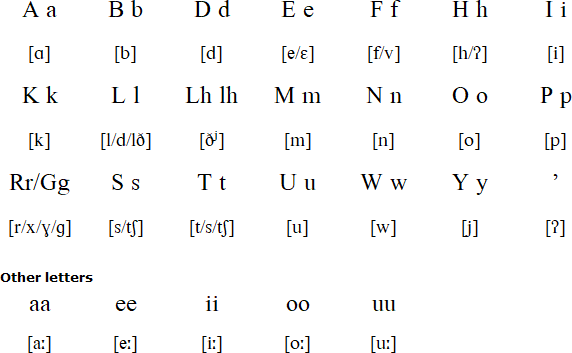
Download an alphabet chart for Wuvulu-Aua (Excel)
Source: https://www.bible.com/bible/1288/LUK.11.WUV
Source: https://www.bible.com/bible/1/LUK.11.KJV
Information about Wuvulu-Aua
https://en.wikipedia.org/wiki/Wuvulu-Aua_language
https://www.sil.org/resources/search/language/wuv
http://language-archives.org/language/wuv
https://www.sil.org/resources/search/language/wuv
Adzera, Ahamb, Äiwoo, Aneityum, Apma, Araki, Are, ʼAuhelawa, Avava, Babatana, Bariai, Bola, Big Numbas, Buhutu, Bwaidoka, Bwanabwana, Caac, Cheke Holo, Daakaka, Dorig, East Ambae, Gapapaiwa, Hiri Motu, Hiw, Hoava, Kakabai, Kaninuwa, Kara, Kilivila, Kokota, Koro. Kove, Kurti, Kwamera, Lakon, Lehali, Lenakel, Lewo, Lote, Lo-Toga, Löyöp, Manam, Marovo, Maskelynes, Mato, Mavea, Mono-Alu, Mota, Motu, Mussau-Emira, Mwerlap, Mwesen, Mwotlap, Nafsan, Nahavaq, Nali, Namakura, Naman, Nanggu, Nduke, Neve‘ei, Neverver, Ninde, North Efate, Nume, Paamese, Papapana, Raga, Rotuman, Roviana, Sa, Sakao, Saliba, Seimat, Siar, Sio, Ske, Sobei, Sudest, Sursurunga, Tamambo, Tami, Teanu, Tigak, Tirax, Tolai, Touo, Tungag, Ubir, Ughele, Uneapa, Vatlongos, Vitu, Vurës, Western Fijian, Wuvulu-Aua, Yabem, Yapese
Languages written with the Latin alphabet
Page created: 30.03.26. Last modified: 01.04.26
[top]

Note: all links on this site to Amazon.com


You can support this site by Buying Me A Coffee, via PayPal or Patreon, or by contributing in other ways.
If you find all the adverts annoying, there is now an Ad-free version of Omniglot which you can access for a small monthly or annual donation.

This website and its content is copyright of Simon Ager - © Simon Ager 1998-2026. All rights reserved. All images were created by me, unless otherwise indicated. More details

[top]


