
Udi is a member of the Lezgian (southern) branch of the Northeast Caucasian languages. It is spoken by about 8,000 people in parts of Azerbaijan, Russia, Georgia and Armenia, with the majority of speakers in the Azerbaijani village of Nij in the Qabala district of northern Azerbaijan. There are also quite a few Udi speakers in villages in Tavush Province in northeastern Armenia.
The Udi language has a long history which is divided into five stages: Early Udi was the language spoken between about 2,000 BC and 300 AD, Old Udi was spoken between 300 and 900 AD, Middle Udi from 900 to 1800 AD, Early Modern Udi from 1800 to 1920, and Modern Udi since then. It is thought that Old Udi was used exclusively as the liturgical language of the Church of Caucasian Albania from 700 AD. It was written with the Caucasian Albanian alphabet, which was created in the 4th or 5th century AD.
Documentation of Udi started in the mid-19th century, and an Udi Grammar, by Anton Antonovich Schiffner, was published in 1863. An Udi translation of part of the Bible was published in 1902, and a small number of publications in Udi have appeared since then.
Since 1992 Udi has been taught in primary schools in Nij. Initially the Cyrillic alphabet was used, but towards the end of the 1990s a way of writing Udi with the Latin alphabet was devised.
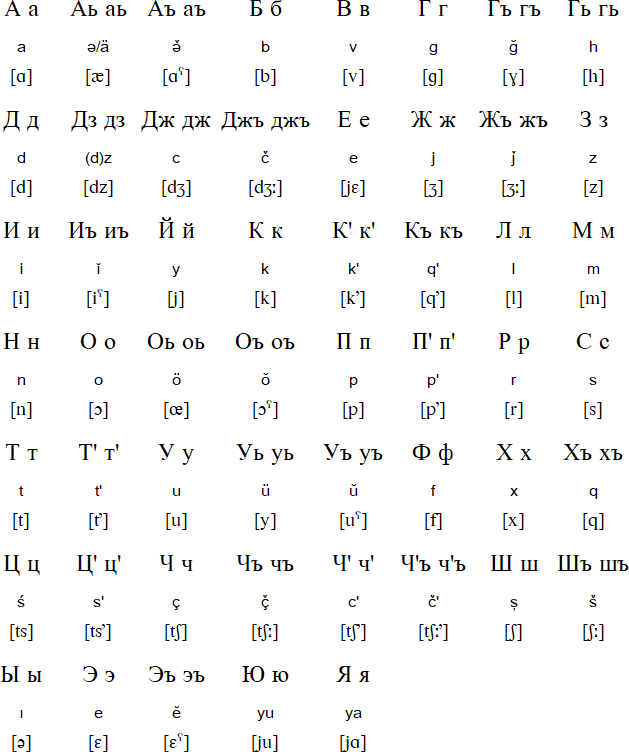
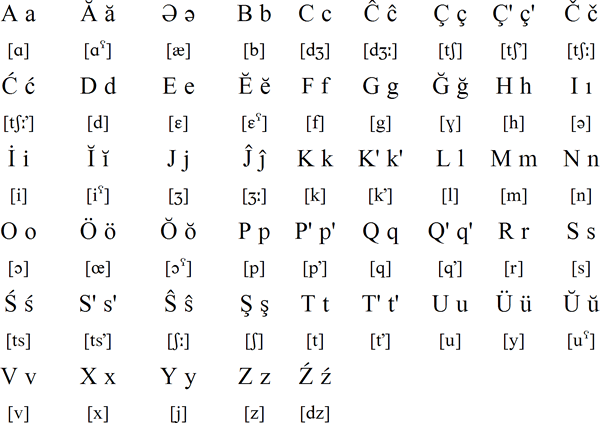
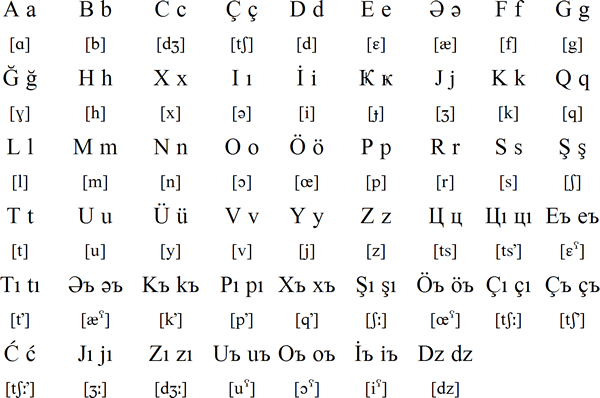
Download alphabet charts for Udi (Excel)
Sa pasç'ağen sa pasç'ağax ç'axpi. Yesirreaq'sa enesça iç ölkina iç k'ua enefsa şet'a pasç'ağluğaxal zaft'ebsa. Q'a usenaxo yesir pasç'ağen xoiŝnebsa me pasç'ağax te vatanbez ixbaft'e, barta bez ölkinax tağa furuk'az.
Са пасч'агъэн са пасч'агъаx ч'аxпи. Есиррэакъса энэсча ич оьлкина ич к'уа энэфса шэт'а пасч'агълугъаxал зафт'эбса. Къа усэнаxо yэсир пасч'агъэн xоишънэбса mэ пасч'агъаx тэ ватанбэз иxбафт'э, барта бэз оьлкинаx тагъа фурук'аз.
Source: http://wschulze.userweb.mwn.de/sampletxt.htm
A king caught a king, imprisoned him and carried him to his own land, keeping in his own house. He ruled over that kingdom, too. After 20 years, the imprisoned king asked this king: I'm thinking of my homeland, allow me to go to my land and I will examine it.
Details of the Udi alphabets, pronunciation and sample texts provided by Michael Peter Füstumum
Information about Udi | Caucasian Albanian (Old Udi) script | Phrases | Numbers (Udi) | Numbers (Old Udi / Caucasian Albanian )
Information about the Udi language
http://en.wikipedia.org/wiki/Udi_language
http://az.wikipedia.org/wiki/Udi_dili
http://titus.fkidg1.uni-frankfurt.de/didact/caucasus/nekklaut.htm#XFN10
http://titus.fkidg1.uni-frankfurt.de/ecling/ecling03.htm
http://wschulze.userweb.mwn.de/udinhalt.htm
Aghul, Akhvakh, Andi, Archi, Avar, Bagvalal, Batsbi, Bezhta, Botlikh, Budukh, Caucasian Albanian, Chamalal, Chechen, Dargwa, Godoberi, Hinukh, Hunzib, Ingush, Kaitag, Karata, Khinalug, Khwarshi, Kryts, Kubachi, Lak, Lezgian, Rutul, Tabassaran, Tindi, Tsakhur, Tsez, Udi
Abaza, Abkhaz, Adyghe, Aghul, Akhvakh, Akkala Sámi, Aleut, Altay, Alyutor, Andi, Archi, Assyrian / Neo-Assyrian, Avar, Azeri, Bagvalal, Balkar, Bashkir, Belarusian, Bezhta, Bosnian, Botlikh, Budukh, Bulgarian, Buryat, Chamalal, Chechen, Chelkan, Chukchi, Chulym, Chuvash, Crimean Tatar, Dargwa, Daur, Dolgan, Dungan, Enets, Erzya, Even, Evenki, Gagauz, Godoberi, Hinukh, Hunzib, Ingush, Interslavic, Itelmen, Juhuri, Kabardian, Kaitag, Kalderash Romani, Kalmyk, Karaim, Karakalpak, Karata, Karelian, Kazakh, Ket, Khakas, Khanty, Khinalug, Khorasani Turkic, Khwarshi, Kildin Sámi, Kili, Komi, Koryak, Krymchak, Kryts, Kubachi, Kumandy, Kumyk, Kurdish, Kyrgyz, Lak, Lezgi, Lingua Franca Nova, Lithuanian, Ludic, Macedonian, Mansi, Mari, Moksha, Moldovan, Mongolian, Montenegrin, Nanai, Negidal, Nenets, Nganasan, Nivkh, Nogai, Old Church Slavonic, Oroch, Orok, Ossetian, Pontic Greek, Romanian, Rushani, Russian, Rusyn, Rutul, Selkup, Serbian, Shor, Shughni, Siberian Tatar, Sirenik, Slovio, Soyot, Tabassaran, Tajik, Talysh, Tat, Tatar, Teleut, Ter Sámi, Tindi, Tofa, Tsakhur, Tsez, Turkmen, Tuvan, Ubykh, Udege, Udi, Udmurt, Ukrainian, Ulch, Urum, Uyghur, Uzbek, Veps, Votic, Wakhi, West Polesian, Xibe, Yaghnobi, Yakut, Yazghulami, Yukaghir (Northern / Tundra), Yukaghir (Southern / Kolyma), Yupik (Central Siberian)
Languages written with the Latin alphabet
Page last modified: 20.08.23
[top]

You can support this site by Buying Me A Coffee, and if you like what you see on this page, you can use the buttons below to share it with people you know.

If you like this site and find it useful, you can support it by making a donation via PayPal or Patreon, or by contributing in other ways. Omniglot is how I make my living.
Note: all links on this site to Amazon.com


[top]


