
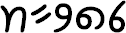
The Mahajani alphabet was used in northern India until the mid-20th century to write Hindi, Marwari, Punjabi and other languages. It was used mainly for commercial purposes, and was taught in schools in Punjab, Rajasthan, Uttar Pradesh, Bihar and Madhya Pradesh where students were mainly from merchant and trading communities. It is thought to have developed from the Kaithi script, with influences from Devanagari.
According to a 2004 report in the Tribune, a newspaper in Chandigarh, Langdi Hindi, a variety of the Haryanvi language written in the Mahajani alphabet was used for bookkeeping until the early 21st century.
The name Mahajani comes from the Hindi word महाजन (mahājana), which means banker. The script was used mainly by bankers and money lenders in accounts, merchant diaries, and other finanical documents. There are also books for teaching the script, such as primers and grammars.
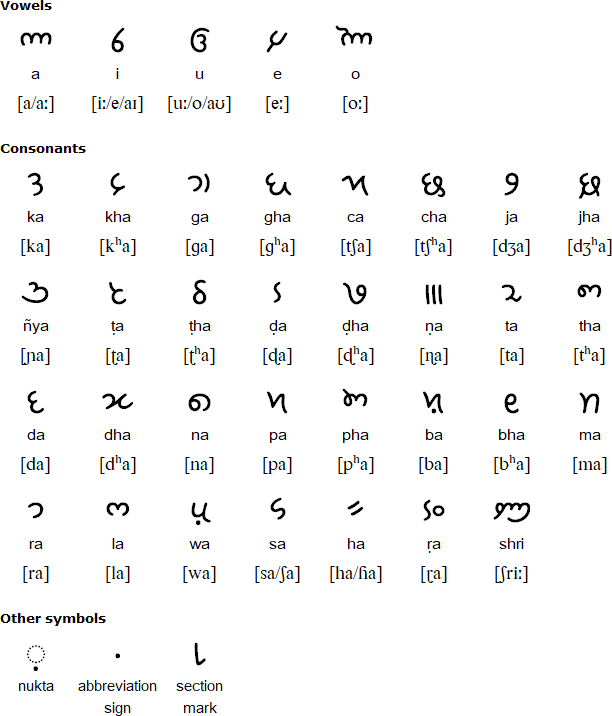
The nukta symbol is used for writing sounds that are not represented by a unique character, such as allophonic variants and sounds that occur in local dialects or in loanwords.
Download an alphabet chart for Mahajani (Excel)
Details supplied by Biswajit Mandal (biswajitmandal[dot]bm90[at]gmail[dot]com)

Source: https://www.unicode.org/L2/L2011/11274-n4126-mahajani.pdf

anirodham anutpādam anucchedam aśāśvatam .
anekārtham anānārtham anāgamam anirgamam ..
yaḥ pratītyasamutpādaṃ prapañcopaśamaṃ śivam .
deśayāmāsa saṃbuddhastaṃ vande vadatāṃ varam ..
Source: https://aksharamukha.appspot.com/describe/Mahajani
Information about Mahajani
https://en.wikipedia.org/wiki/Mahajani
https://writingsystems.info/scrlang/scripts/mahj/
https://aksharamukha.appspot.com/describe/Mahajani
https://www.unicode.org/L2/L2011/11274-n4126-mahajani.pdf
Ahom, Aima, Arleng, Badagu, Badlit, Basahan, Balinese, Balti-A, Balti-B, Batak, Baybayin, Bengali, Bhaiksuki, Bhujimol, Bilang-bilang, Bima, Blackfoot, Brahmi, Buhid, Burmese, Carrier, Chakma, Cham, Cree, Dehong Dai, Devanagari, Dham Lipi, Dhankari / Sirmauri, Ditema, Dives Akuru, Dogra, Ethiopic, Evēla Akuru, Fox, Fraser, Gond, Goykanadi, Grantha, Gujarati, Gunjala Gondi, Gupta, Gurmukhi, Halbi Lipi, Hanifi, Hanuno'o, Hočąk, Ibalnan, Incung, Inuktitut, Jaunsari Takri, Javanese, Kaithi, Kadamba, Kamarupi, Kannada, Kawi, Kharosthi, Khema, Khe Prih, Khmer, Khojki, Khom Thai, Khudabadi, Kirat Rai, Kōchi, Kodava Lipi, Komering, Kulitan, Kurukh Banna, Lai Tay (Tai Yo), Lampung, Lanna, Lao, Leke, Lepcha, Limbu, Lontara/Makasar, Lota Ende, Magar Akkha, Mahajani, Malayalam, Meitei (Modern), Manpuri (Old), Marchen, Meetei Yelhou Mayek, Meroïtic, Masarm Gondi, Modi, Mon, Mongolian Horizontal Square Script, Multani, Nandinagari, Newa, New Tai Lue, Ojibwe, Odia, Ogan, Pahawh Hmong, Pallava, Phags-pa, Purva Licchavi, Qiang / Rma, Ranjana, Rejang (Kaganga), Sasak, Savara, Satera Jontal, Shan, Sharda, Sheek Bakrii Saphaloo, Siddham, Sinhala, Sorang Sompeng, Sourashtra, Soyombo, Sukhothai, Sundanese, Syloti Nagri, Tagbanwa, Tai Noi, Takri, Tamil, Tanchangya (Ka-Pat), Tani, Thaana, Telugu, Thai, Thirke, Tibetan, Tigalari, Tikamuli, Tocharian, Tolong Siki, Vatteluttu, Warang Citi
Page last modified: 09.10.26
[top]

Note: all links on this site to Amazon.com


You can support this site by Buying Me A Coffee, via PayPal or Patreon, or by contributing in other ways.
If you find all the adverts annoying, there is now an Ad-free version of Omniglot which you can access for a small monthly or annual donation.

This website and its content is copyright of Simon Ager - © Simon Ager 1998-2026. All rights reserved. All images were created by me, unless otherwise indicated. More details

[top]


