
Oroch is a Tungusic language spoken in eastern Siberia in the Russian Federation by about 8 people. It is spoken the Komsomolsky, Sovetskaya Gavan and Ulchsky districts of Khabarovsk Krai. There were three dialects: Tumninsky, Khadinsky and Hungarisky. Oroch is closely related to the Nanai and Udege languages. It is classified as 'nearly extinct'.
The Oroch people originally called themselves нани ("man of the earth, people"), but now call themselves орочи ("deer-possessing/raising"), although they do not raise deer. This name is thought to have been spread by J.F. Laperouse, a French sailor who visited the area where they live in 1787.
A way of writing Oroch was devised at the beginning of the 21st century.
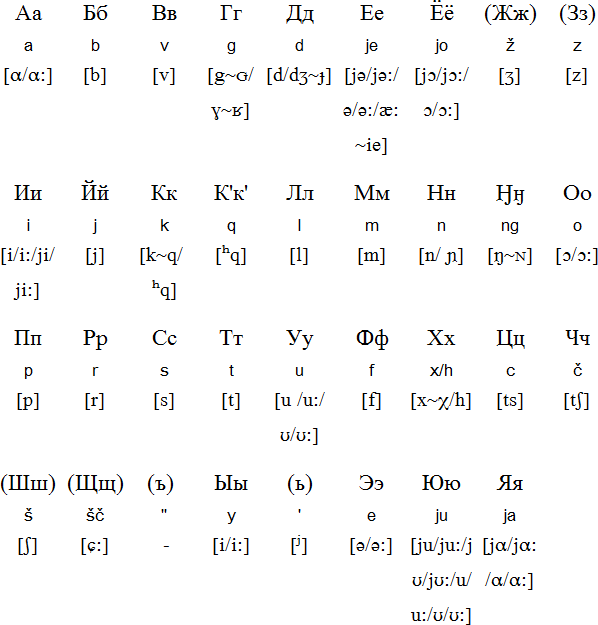
Information about Oroch pronunciation provided by 이윤호
Нима̄пу
Нима̄пу даӈса ду.
Нима̄пу даӈса ду.
Наму дагга хэм ая ба̄тунгу
Ниду сулакиду ӈоними игги,
ӈочкони игги туксаиду мападу.
Хоё, лака.
Бая, дёчонку.
Дяггу.
Амбани хитэ.
Дю экэ.
Тэ̄луӈду.
Information about Oroch | Numbers in Oroch
Information about Oroch
http://en.wikipedia.org/wiki/Oroch_language
https://www.ethnologue.com/language/oac
http://lingsib.iea.ras.ru/en/languages/oroch.shtml
Even, Evenki, Jurchen, Kili, Manchu, Nanai, Negidal, Oroch, Orok / Uilta, Oroqen, Udege Ulch, Xibe
Abaza, Abkhaz, Adyghe, Aghul, Akhvakh, Akkala Sámi, Aleut, Altay, Alyutor, Andi, Archi, Assyrian / Neo-Assyrian, Avar, Azeri, Bagvalal, Balkar, Baraba Tatar, Bashkir, Belarusian, Besermyan, Bezhta, Bosnian, Botlikh, Budukh, Bulgarian, Buryat, Chamalal, Chechen, Chelkan, Chukchi, Chulym, Chuvash, Crimean Tatar, Dargwa, Daur, Dolgan, Dungan, Enets, Erzya, Even, Evenki, Gagauz, Godoberi, Hinukh, Hunzib, Ingush, Interslavic, Itelmen, Juhuri, Kabardian, Kaitag, Kalderash Romani, Kalmyk, Karaim, Karakalpak, Karata, Karelian, Kazakh, Ket, Khakas, Khanty, Khinalug, Khorasani Turkic, Khwarshi, Kildin Sámi, Kili, Komi, Komi-Permyak, Komi-Yazva, Komi-Zyrian, Koryak, Krymchak, Kryts, Kubachi, Kumandy, Kumyk, Kurdish, Kyrgyz, Lak, Lezgi, Lingua Franca Nova, Lithuanian, Ludic, Macedonian, Mansi, Mari, Moksha, Moldovan, Mongolian, Montenegrin, Nanai, Negidal, Nenets, Nganasan, Nivkh, Nogai, Old Church Slavonic, Oroch, Orok, Oroqen, Ossetian, Pontic Greek, Romanian, Rushani, Russian, Rusyn, Rutul, Selkup, Serbian, Shor, Shughni, Siberian Tatar, Sirenik, Slovio, Soyot, Tabassaran, Tajik, Talysh, Tat, Tatar, Teleut, Ter Sámi, Tindi, Tofa, Tsakhur, Tsez, Tsudaqar, Turkmen, Tuvan, Ubykh, Udege, Udi, Udmurt, Ukrainian, Ulch, Urum, Uyghur, Uzbek, Veps, Votic, Wakhi, West Polesian, Xibe, Yaghnobi, Yakut, Yazghulami, Yukaghir (Northern / Tundra), Yukaghir (Southern / Kolyma), Yupik (Central Siberian)
Languages written with the Latin alphabet
Page last modified: 27.11.23
[top]

You can support this site by Buying Me A Coffee, via PayPal or Patreon, or by contributing in other ways.
If you find all the adverts annoying, there is now an Ad-free version of Omniglot which you can access for a small monthly or annual donation.

Note: all links on this site to Amazon.com


This website and its content is copyright of Simon Ager - © Simon Ager 1998-2026. All rights reserved. All images were created by me, unless otherwise indicated. Feel free to use them for personal, educational or non-commercial purposes, and don't forget to mention where they came from. More details about copyright

[top]


