
Romanian is a Romance language spoken mainly in Romania, Moldova and Transnistria. Other countries with a significant number of Romanian speakers include Serbia, Ukraine, Hungary, Italy, Spain, Germany, Russian, Israel, the USA and Canada. In 2016 there were about 24 million speakers of Romanian worldwide, including about 17 million in Romania, 2.5 million in Moldova, 177,000 in Transnistria, 1.1 million in Italy, 800,000 in Spain and 327,000 in Ukraine.
Romanian is a member of the Balkan-Romance or Eastern Romance branch of the Romance languages. It developed from Vulgar Latin, which was brought to the region by the Romans, who conqured it in 105-106 AD. At that time the area that corresponds to modern Romania, Moldova and parts of Bulgaria, Serbia, Hungary, Poland, Slovakia and Ukraine, was known as Dacia. It became a province of the Roman Empire known as Dacia Traiana.
Romanian retains a number of features of Latin, such as noun cases, which have disappeared from other Romance languages. It also contains words from the surrounding Slavic languages, from French, Old Church Slavonic, German, Greek and Turkish, and also from Dacian, an extinct Indo-European language that was spoken in Dacia until about the 7th century AD.
[top]
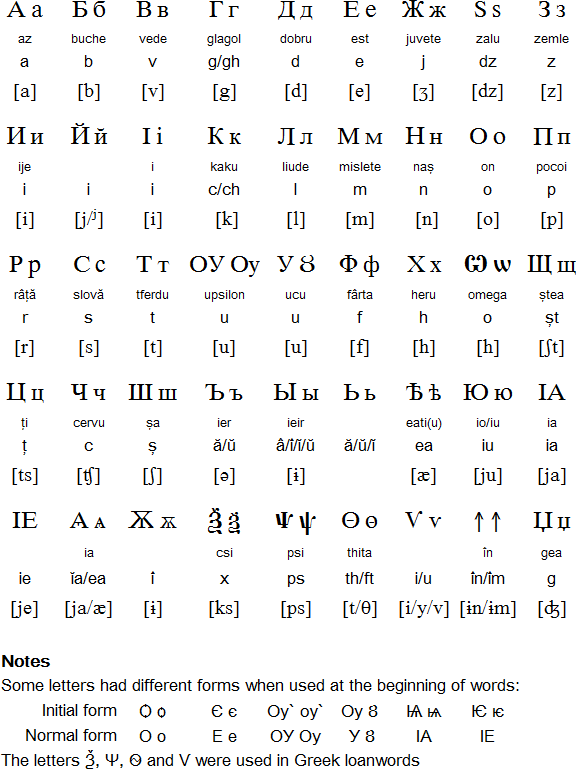
Romanian first appeared in writing during the 16th century, mainly in religious texts and other documents. The earliest known text in Romanian, which dates from 1521, is a letter from Neacşu of Câmpulung to the mayor of Braşov. Neacşu wrote in a version of the old Cyrillic alphabet similar to the one for Old Church Slavonic, which was used in Walachia and Moldova until 1859.
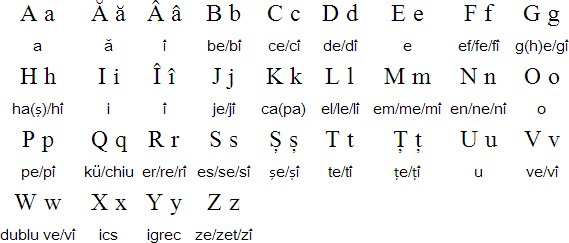
From the late 16th century a version of the Latin alphabet using Hungarian spelling conventions was used to write Romanian in Translyvania. Then in the late 18th century a spelling system based on Italian was adopted.
A version of the Cyrillic alphabet was used in the Soviet Republic of Moldova until 1989, when they switched to the Romanian version of the Latin alphabet.
[top]
[top]
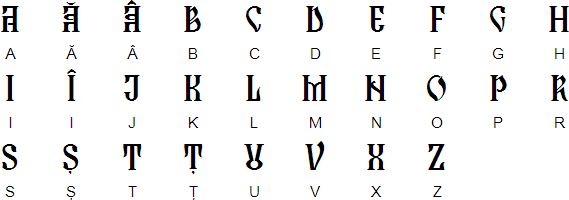
This alphabet was created in around 1930 in an effort to find a connection with the past. The alphabet is Latin, but the letters shapes resemble Cyrillic letters. It is sometimes used in church writings for titles and short texts.
[top]
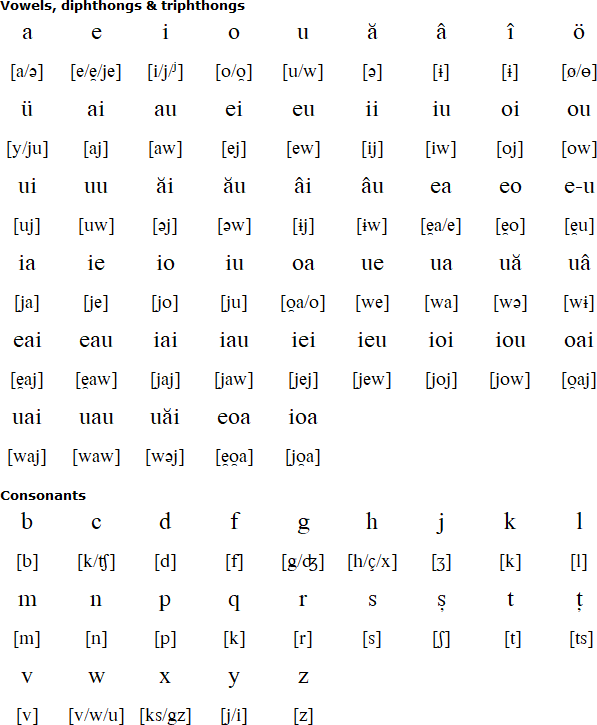
Hear how to pronounce Romanian:
[top]
Download alphabet charts for Romanian (Excel)
[top]
Toate ființele umane se nasc libere și egale în demnitate și în drepturi. Ele sunt înzestrate cu rațiune și conștiință și trebuie să se comporte unele față de altele în spiritul fraternității.
A recording of this text by Georgescu Alexandru Cristian
All human beings are born free and equal in dignity and rights. They are endowed with reason and conscience and should act towards one another in a spirit of brotherhood.
(Article 1 of the Universal Declaration of Human Rights)
Information about Romanian | Useful phrases | Silly phrases | Numbers | Family words | Time | Tower of Babel | Books about Romanian on: Amazon.com and Amazon.co.uk [affilate links]
[top]
Information about the Romanian language
http://en.wikipedia.org/wiki/Romanian_language
https://ro.wikipedia.org/wiki/Limba_română
The Letter of Neacşu of Câmpulung (the first written document in Romanian)
http://www.cimec.ro/Istorie/neacsu/eng/
Online Romanian lessons
http://www.easyromanian.com
https://www.learnro.com/
http://simpleromanian.com/
https://www.clozemaster.com/blog/topics/language-learning/learn-romanian/
http://www.romanianpod101.com/
Romanian phrases
http://www.romanianlesson.com/common-romanian-words
http://www.bbc.co.uk/languages/other/quickfix/romanian.shtml
http://wikitravel.org/en/Romanian_phrasebook
Online Romanian dictionaries
http://www.dictionare.com
http://ro-en.gsp.ro
http://dexonline.ro
http://www.dictionarroman.ro
http://dictionarromanfrancez.net
http://www.alcor.com.au/romanian_rhyming_dictionary.asp
http://www.dictionar.us
http://hallo.ro
Fonts for Old Romanian
https://florinf.ro/fonturi-arhaic-romanesc-si-nu-numai/
Online Romanian radio
http://www.rri.ro
http://www.europalibera.org
http://www.europafm.ro
http://www.kissfm.ro
http://doctorulfm.blogspot.co.uk/
Televiziunea Româna (Romanian Television - includes live online programmes)
http://www.tvr.ro
Online Romanian news
http://www.expres.ro
http://www.ziare.com
http://www.jurnalul.ro
http://www.cotidianul.ro
http://www.romanialibera.ro
Learn Romanian online with RomanianPod101
Find Romanian Tutors with LanguaTalk
Learn Romanian with Ling
Aragonese, Aranese, Aromanian, Asturian, Catalan, Corsican, Dalmatian, Emilian, Extremaduran, Fala, Franco-Provençal, French, Friulian, Galician, Gallo, Gascon, Genoese, Guernésiais, Istro-Romanian, Istriot, Italian, Jèrriais, Ladino, Ladin, Leonese, Ligurian, Lombard, Lorrain, Megleno-Romanian, Mirandese, Moldovan, Monégasque, Mozarabic, Neapolitan, Occitan, Occitan (Auvergnat), Occitan (Languedocien), Occitan (Limousin), Occitan (Provençal), Picard, Piedmontese, Portuguese, Romagnol, Romanian, Romansh, Sardinian, Sicilian, Spanish, Valencian, Venetian, Walloon
Abaza, Abkhaz, Adyghe, Aghul, Akhvakh, Akkala Sámi, Aleut, Altay, Alyutor, Andi, Archi, Assyrian / Neo-Assyrian, Avar, Azeri, Bagvalal, Balkar, Baraba Tatar, Bashkir, Belarusian, Besermyan, Bezhta, Bosnian, Botlikh, Budukh, Bulgarian, Buryat, Chamalal, Chechen, Chelkan, Chukchi, Chulym, Chuvash, Crimean Tatar, Dargwa, Daur, Dolgan, Dungan, Enets, Erzya, Even, Evenki, Gagauz, Godoberi, Hinukh, Hunzib, Ingush, Interslavic, Itelmen, Juhuri, Kabardian, Kaitag, Kalderash Romani, Kalmyk, Karaim, Karakalpak, Karata, Karelian, Kazakh, Ket, Khakas, Khanty, Khinalug, Khorasani Turkic, Khwarshi, Kildin Sámi, Kili, Komi, Komi-Permyak, Komi-Yazva, Komi-Zyrian, Koryak, Krymchak, Kryts, Kubachi, Kumandy, Kumyk, Kurdish, Kyrgyz, Lak, Lezgi, Lingua Franca Nova, Lithuanian, Ludic, Macedonian, Mansi, Mari, Moksha, Moldovan, Mongolian, Montenegrin, Nanai, Negidal, Nenets, Nganasan, Nivkh, Nogai, Old Church Slavonic, Oroch, Orok, Oroqen, Ossetian, Pontic Greek, Romanian, Rushani, Russian, Rusyn, Rutul, Selkup, Serbian, Shor, Shughni, Siberian Tatar, Sirenik, Slovio, Soyot, Tabassaran, Tajik, Talysh, Tat, Tatar, Teleut, Ter Sámi, Tindi, Tofa, Tsakhur, Tsez, Tsudaqar, Turkmen, Tuvan, Ubykh, Udege, Udi, Udmurt, Ukrainian, Ulch, Urum, Uyghur, Uzbek, Veps, Votic, Wakhi, West Polesian, Xibe, Yaghnobi, Yakut, Yazghulami, Yukaghir (Northern / Tundra), Yukaghir (Southern / Kolyma), Yupik (Central Siberian)
Languages written with the Latin alphabet
Thanks to Adrian Homutescu, Bogdan Banu and Florin Florea for providing material, suggestions and corrections for this page.
Page last modified: 17.11.24
[top]

Note: all links on this site to Amazon.com


You can support this site by Buying Me A Coffee, via PayPal or Patreon, or by contributing in other ways.
If you find all the adverts annoying, there is now an Ad-free version of Omniglot which you can access for a small monthly or annual donation.

This website and its content is copyright of Simon Ager - © Simon Ager 1998-2026. All rights reserved. All images were created by me, unless otherwise indicated. More details

[top]



Shipping time world-
wide is typically 6 days.